Showing posts with label Chinese New Year. Show all posts

Monday, February 9, 2009

Feb 09: The Fifth Taste?

When I was in elementary school, we learned that tongue had four taste receptors - sweet, sour, salty and bitter. Well... that was the olden days. Now, there is a belief that we have a fifth taste receptor - Umami.

Uma-what? Umami! Umami is a Japanese term that refers to a flavor that's savory, not just salty, but meaty too. These taste buds respond to glutamates. That's one reason that MSG is a popular seasoning... MSG represents umami.

From Wiki, foods that contain glutamates: soy sauce, fish sauce, kombu, mushrooms, anchioves, parmasean.

There's a Chinese New Year dish, which I haven't had in 20 to 25 years, but I still remember the strong flavors and the crunch of water chestnuts. I think it was the umami of the dish that made this dish stand out.

Here's my attempt at make the dish - Lettuce cups with dried oyster filling.

Oysters (hao si) is a symoblic food since hao sounds like "good" or "good fortune". Lettuce is symbolic of "prosperity".

Lettuce Cups with Dried Oysters
1/3 C (about 5) large dried oysters, soaked a few hours to overnight to rehydrate
1/4 C Water Chestnut, minced
1/2 lb Ground Pork
1/4 C Carrot, minced (for color)
1/4 C Shiitake Mushroom, rehydrated and minced
1 Clove Garlic, minced
1/2 t Ginger, grated
1 Green Onion, chopped
1/4 C Stock
1 T Oyster Sauce
2 t Soy Sauce, Regular
2 t Soy Sauce, Dark

Picture of the rehydrated oyster.


Soaking the oysters made for easier mincing.


The rest of the ingredients.


1. In a hot wok or saute pan, add about 1 T oil and slightly fry the garlic and ginger (30 seconds) add the pork to start cooking... About 1 minute add the oysters.


2. I became impatient and added the rest of the ingredients and seasoning.
Stir to break up the ground pork. Add the broth and cook for about 10 minutes.
The dish did not look as dark as I remembered so I dug around my pantry and found some dark soy sauce.


The finished dish - minced meat and lettuce cups.


Scoop some of the filling into a lettuce cup and fold to eat like a lettuce taco. :-)


The dish turned out very close to what I remember.
Looking at the ingredients, this dish is laden with umami flavors - dried oyster, dried mushrooms and soy sauce (two kinds), oyster sauce and possibly the garlic.

Notes:
Add more water chestnut for more crunch.
Add more oysters or use less ground pork... in order to have a stronger oyster flavor.
Not sure If I really need the ginger or carrots.

Tuesday, January 27, 2009

Jan 27: CNY Poached Chicken

This past week has been very foggy with no sun in sight for at least 3 days in a row where visibility hovered around 50 ft to 1/4 mile. I thought I was in a Stephen King movie! On top of that, we received an Artic blast with freezing temperatures plus the fog.

Imagine my surprise when I looked at my Wisteria. The fog and cold air created mini-icicle thorns!


Chinese New Years is approximately a 2 week celebration filled with symbolic foods and family gatherings.

One such foods is chicken, which represents joy. I'd be joyful too with a bucket of fried chicken! However, no fried chicken tonight, in fact the opposite. The chicken is poached.

We called it "dem gai" which means "soaked chicken". I hope that's the meaning. My Cantonese comprehension is probably at the first grade level. Actually, I think it's below the first grade level. lol. Another name is "white cut chicken".

The resulting chicken should be very velvety, juicy and tender. This is a result of the long soaking.

Here's the recipe I used for tonight. Due to my time constraints, I ended up poaching the chicken.

White Cut Chicken
1 Chicken, 5 lbs
6 quarts Water
2 Green Onions,, coarsely cut
1 Clove Garlic, smashed
3 slices Ginger, about the size of a quarter
1/2 to 1 teaspoon salt

1. Add the green onions, garlic, ginger to the water and bring to a boil for about 5 minutes. [Traditionally, my parents would just use salt since the broth would be added to other dishes where the garlic and ginger would clash with the flavors.]
2. Wash and dry the chicken. Rub the salt on the skin and sprinkle into the cavity.
3. Add the chicken to the water... Breast side up. My reasoning is the breast will cook faster than the dark meat. [I don't know if my parents really had this as a rule, but it makes sense to me.]
4. The chicken is added to that pot and the heat is increased until the water barely simmers. [I added the thermometer just to see the temp... About 185F to 190F]


5. Poach for about 45 minutes with the water at 185F. [The traditional recipe is to actually bring back to a boil, lower the heat to simmer for 15 minutes... with the final step of turning off the heat and allow the chicken to soak in the hot liquid for about 1 hour.]

Flavoring/Condiments

1/ Oyster sauce is used as a dipping sauce.

2/ I remember during the New Year banquets there was a little dish of seasoned salt... which I think was ground Sichuan peppercorns mixed with salt.
Sichuan Peppercorn Salt
1 t Sichuan Peppercorns, roasted in a pan until fragrant.
1 T Salt

Blend in a coffee grinder.

Sichuan Peppercorns. The actual flavor comes from the outer coating of the berry.


If you have the patience, pick out the black seeds from the peppercorn.


3/ Another condiment is a garlic-ginger-scallion mixture that's mashed with salt and hot oil. This is similar to a gremolata.

Garlic-Ginger-Scallion Condiment

1 tsp Ginger, coarsely chopped
1 clove Garlic, minced
2 Green Onions, finely cut
1/2 tsp Salt, kosher
1T Oil... I used canola.

The garlic, ginger, green onion and salt mixture.


No mortar and pestle... Use the end of the cleaver!


Heat the oil until it ripples... Pour the hot oil into the mash mixture. I added the mixture to the pan to slightly cook, in order to tone down the raw flavors in the mixture.


The finished chicken!
Since the chicken was poached, there was no browning... Hence the name, "White cut chicken."


Legs, thigh and wings are removed to allow the breast to be cut into smaller portions.


The chicken is now ready to eat. The condiments from left to right... Oyster sauce, Sichuan Peppercorn dipping salt and the garlic-scallion-ginger mixture.


I could tell the by the chicken breast that I could have pulled the chicken out a little earlier or turn off the heat at 30 minutes and just let the ambient heat finish the cooking.

Overall, the chicken was moist, but not as velvety as I had hoped... still good though. :-)

Monday, January 26, 2009

Jan 26: Happy CNY 2009!

Happy Chinese New Year!
Many wishes of happiness, prosperity and good health for the new year!

Starting off the year with Jai which is a vegetarian dish, also known as, Buddha Delight.

This year I made the dish a little different than last year, http://eat4fun.blogspot.com/2008/02/happy-chinese-new-year.html.

Mainly, due to difficulty finding ingredients and forgetting that Chinese New Year was today! :)

Same as last year...
Lily buds (Golden needles - wealth) - soak to rehydrate
Cloud Ears (Longevity) - soak to rehydrate
Dried Mushrooms - soak to rehydrate
Bamboo Shoots
Carrots - cut into disk
Fried Tofu Puffs
Mung Bean Vermicelli (Longevity) - soak to rehydrate
Soy Bean Sprouts
Snow Peas
Nappa Cabbage

Added this year...
Green Onion
Garlic
Baby Corn (also known as Tom Hank's Corn)
Brown Sugar

1. Saute onion and garlic with lily buds, mushrooms, cloud ears, bamboo shoots.
2. Add about 1/2 cup water cover, soy sauce and brown sugar and steam for 15 minutes.
3. Add the remaining ingredients to steam about 5 to 10 minutes... adjust seasoning to your taste.

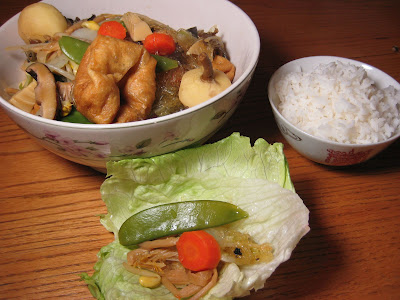
The finished dish: Served with lettuce and rice.


Items I didn't have:
Arrowhead (Market sold out)
Vegetable Broth (Forgot it on my list)

Thursday, February 7, 2008

Happy Chinese New Year!

Today is the start of the New Year per the Chinese lunar calendar. As with other cultures, you need to start the New Year properly by eating the right foods.

One traditional new year dish is Jai. What does Jai mean? I don't know. However, the symbolism of Jai, which is a vegetarian dish, is that the first meal of the day should not involve killing. Depending upon the region or family, the first few days are vegetarian, the first day is vegetarian, the first meal is vegetarian or the dish is on the table for breakfast. Also, jai is chockful of good luck, prosperity and longevity symbolic foods.

This is my version of Jai, plucked from my memory. Also, there is no real set recipe for Jai. If I'm wrong, my parents will probably let me know. :-)

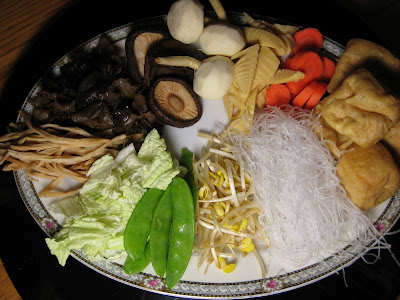
The fixins (staring 9 o'clock and going clockwise)

Lily buds (Golden needles - wealth) - soak to rehydrate
Cloud Ears (Longevity) - soak to rehydrate
Dried Mushrooms - soak to rehydrate
Arrowhead (Benovolence) - peel but keep the stem attached
Bamboo Shoots
Carrots - cut into disk
Fried Tofu Puffs
Mung Bean Vermicelli (Longevity) - soak to rehydrate
Soy Bean Sprouts
Snow Peas
Nappa Cabbage

Vegetable Stock (not shown)
Soy Sauce (not shown)


Simmer in vegetable broth the lily buds, cloud ears, mushrooms, arrowhead, bamboo shoots, carrots and tofu puffs about 15 minutes.

Add the vermicelli, soy bean sprouts, snow peas and nappa cabbage and continue simmering about 5 to 10 minutes.

Add soy sauce to taste.

Serve with rice.
While I was cooking the dish, I had a flash and remembered eating lettuce cups too. Lettuce is symbolic of good luck or something good. Doubly blessed by eating Jai wrapped in lettuce. lol!


I found the following link that has a better explanation for Jai: http://starbulletin.com/98/01/14/features/story1.html