Showing posts with label corned beef. Show all posts

Tuesday, March 17, 2009

Mar 17: Steamed Corned Beef

Happy St Patrick's Day 2009!

This year I wanted to cook corned beef differently.
On busy days, I've cooked corned beef in a slow cooker.
For last year's St. Patrick's Day, I boiled corned beef.
I've, also, baked corned beef low and slow..

After watching a show how some popular delis cook their corned beef and pastrami, I was inspired to steam corned beef for 2009.

Why the different cooking methods? Just to see the end result and whether one method is far better than another.

What you need:
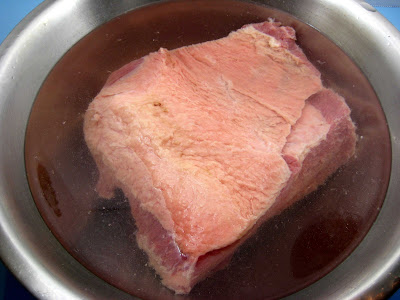
1 Corned Beef, rinsed
1 bottle of Guinness (optional)
Pickling spice from the corned beef
Water
Some type of steamer

My steaming setup:
1 Wok with a lid
1 improvised bamboo chopstick rack
1 heavy duty pie pan - with drilled holes


Add the pickling spices from the corned beef, 1 bottle of Guinness and water to raise the level to the chopsticks.


Bring the water to a boil with the inverted pie tin in place.
Carefully, place the beef, with the fat cap up, on the pie tin.
Turn down heat so the water remains at a boil.
Steam for 2 to 2.5 hours.
Remember to check water levels during this period.


After cooking, allow the beef to rest.
Served with steamed cabbage, carrots and onions.
The texture was firm, yet tender.


Review of cooking methods:
1/ Crock Pot - Great for work days when nobody is around. The meat can be a little too cooked resulting in "falling apart" slices.

2/ Boiling/Simmering - The meat is in direct contact with the cooking liquids where you can add as much flavoring as you like. Meat consistency depends upon how long you look.

3/ Slow Roasting - For brisket, being a tougher cut of beef, I used a barbecue technique of cooking at low temps (below 250F) for a long time (more than 4 hours), aka "low and slow".

4/ Steaming - Steam is a wet cooking method where moisture is convected around the meat. Flavoring can be mild since the meat isn't sitting in the cooking liquid.

5/ Roasting - I haven't tried this method where the meat is roasted at temps above 300F. Mainly, due to the fact, roasting goes against conventional wisdom about cooking brisket. High heats, low moisture and short cooking times don't allow the collagen in the brisket to breakdown and gelatinize. However, I will try roasting just to see what the end results will be.

Wednesday, April 2, 2008

Apr 2 - Corned Beef Hash 2

Corned beef hash again?!?!

Actually, since my first attempt at corned beef hash, I've been craving poached eggs.

I'm craving a fluffy, tender, silky smooth poached egg. Corned beef has is just a means to the end.

Corned beef hash... The last time the dish was a little dry so this time I added boiled cabbage and raw onions to add moisture to the mixture.

The Fixins
1/2 C Corned Beef, diced. (That's all I had)
1/2 C Cabbage, boiled and drained
1/2 C Potatoes, Frozen Southern Style Hash Browns (Didn't have fresh)
1/4 Small Onions, coarse chop
1 Clove Garlic
Tarragon
Thyme

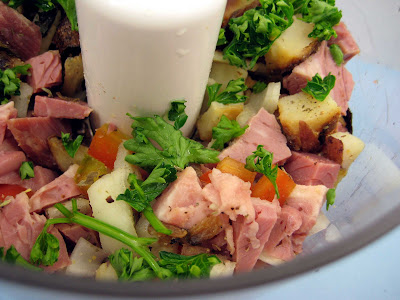
Place ingredients in a food processor.
Corned beef, onions, garlic, thyme and tarragon.


Added potatoes and cabbage


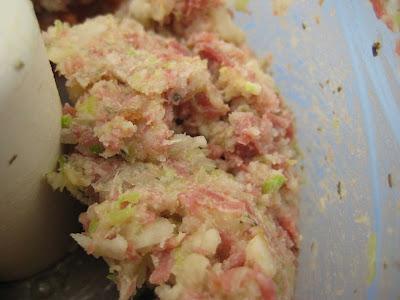
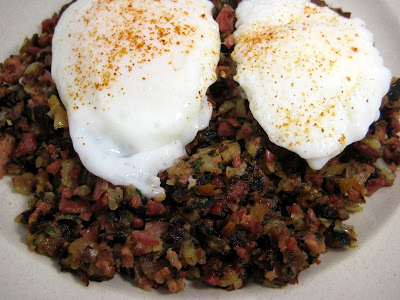
This time I ran the food processor to really mix and grind the ingredients together as shown below.


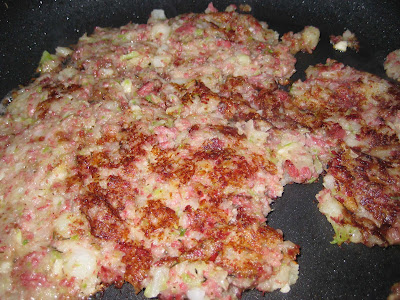
Pan fry in a little butter


Now to the main point of my craving - poaching eggs.
As a gift, I received Julia Child's cookbook, The Way to Cook.

Her method for poaching eggs calls for piercing the egg at the "fat" end where the air sac is located. Next, the egg is submerged in boiling water for 10 seconds. This is supposed to help coagulate a thin film of egg white around the shell which helps keep eggs together when added to the poaching water.

Egg with the small hole at the air sac end.
Note: When I dropped the egg into the boiling water, egg white was shooting out of the hole so I panicked and plucked the egg out after 5 or 6 seconds.


A pot of water is brought to about a simmer where bubbles are barely forming.
2.5 T of vinegar was added to 1 quart of water. The water tasted like a very weak lemon. The acid helps the egg proteins to coagulate instead of spreading out.

The egg poaching away. When I cracked the egg into the water, it sank to the bottom and a small bit stuck to the bottom. I waited a few seconds and used a spatula to gently release the egg. The egg was poached about 4 minutes.


This is my control egg. Just an egg cracked into a custard cup and gently slipped into the water. Interestingly, the egg did spread out more. The vinegar appeared to help keep the egg from really spreading out into thin wisp. Also, note the water is fairly clean. Usually without vinegar there would be stray bits of egg white floating in the poaching liquid. This egg also sank to the bottom of the pan. I used the spatula to release the egg.


The Final Dish
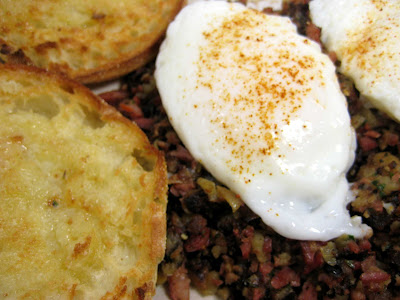
Corned beef hash over toasted English muffin topped with the poached eggs.
The egg on the left is the control egg while the egg on the right is the 10 second boiled egg.


Overall, the corned beef has was a lot better this time around. The extra moisture helped. Surprisingly, Julia Child's 10 second boil method produced a nice looking egg that was very tender (melt in your mouth, sort of) and light. The control egg was fine, but not as fluffy and tender.

BONUS METHOD:
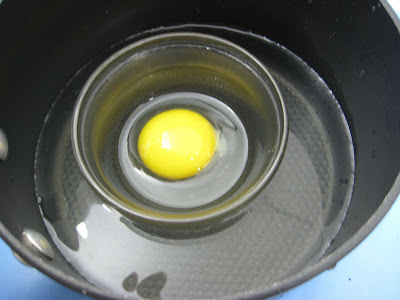
I remember working in a small diner where a customers would occasionally request poached eggs. The eggs were cooked in little metal cups. Since I didn't have any poaching cups, I used a buttered custard cup to cook the egg.

I brought the water to boil with the cup in place. I was worried the cup would crack if I placed the cup into boiling water.


The egg was boiled for about 5 or 6 minutes, covered. When I lifted the lid, I caught a slight whiff of hydrogen sulfide... One reason I really don't like hard boiled eggs.


The egg plated. Retains it's shape. Looks like a flying saucer.


The egg is cooked medium. It's pretty much a hard-boiled egg. Egg whites kind of dense. Not fluffy and tender. Note to self... don't use egg cups when poaching eggs. Julia Child's method and vinegared water is the way to go.

Tuesday, April 1, 2008

Apr 1 - Reuben Sandwich

Leftover Corned Beef = Reuben Sandwich today

A Reuben is a grilled cheese sandwich that has been "deluxed" with sauerkraut, corned beef and Thousand Island dressing. I believe the original Reuben used Russian dressing which I tried to find.

The Fixins'

2 Slices Rye Bread, I used Dark Rye
1/4 C Sauerkraut
Sliced Corned Beef
Swiss Cheese
1 T Thousand Island Dressing (and 1 T French Dressing)
Soft butter

Since I was trying two different dressings, I sliced the bread in half.
Apply soft butter to the outside of the sandwich bread.
On the inner surface, apply the dressing.
Spread out the sauerkraut and layer in the corned beef.
Top with Swiss cheese.
Toast in a frying pan

The finished sandwich


Overall, the sandwich had a nice buttery exterior. The sauerkraut was tangy and crisp, but not overly sour.

Comparing the two dressings. The Thousand Island added a nice creaminess to the sandwich and what I'm used to. The French dressing was too weak to stand up against the sauerkraut. French dressing is a red ketchup-like dressing. The French dressing is not as sweet as ketchup and is slightly more vinegary. However, it didn't stand up to the sauerkraut. I was hoping the French dressing's vinegariness would cut through the fattiness of the grilled cheese, butter and corned beef. Are those real words?

I wonder if I should have supplemented the French dressing with a little horseradish?
I need to research the difference between Russian dressing and French dressing.

Sunday, March 30, 2008

Slow Roasted Corned Beef - Snow again!?!?

Snowing again today and today, Sunday, I was called into work.

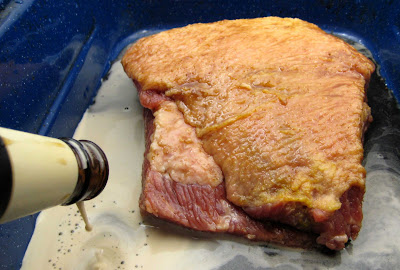
I decided to slow roast a corned beef I purchased at Costco.

First, I washed off the corned beef and let the corned beef soak in clean water for about 30 minutes, usually I would soak overnight to draw out any excess salt. I don't know if a 30 minutes soak does a lot or not, but I gave it a shot.


The Costco corned beef is a USDA Choice brisket and usually not overly salty. Also, looking at the cross-section, it's nicely colored, lean and not tough looking (plump, not dry and stringy).


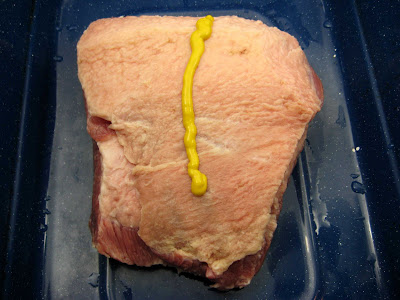
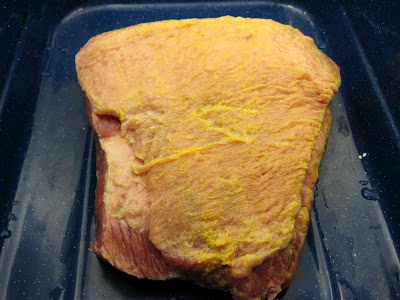
When I bake brisket, I usually give it a light mustard coating. This is a technique I picked up in a barbecuing class for smoked ribs, since I'm cooking the brisket low and slow I used mustard on the brisket.


The mustard was rubbed on all surfaces on the corned beef. Also, when cooked you don't get a mustard flavor in the meat, but it adds a little layer of flavor that's not overpowering.


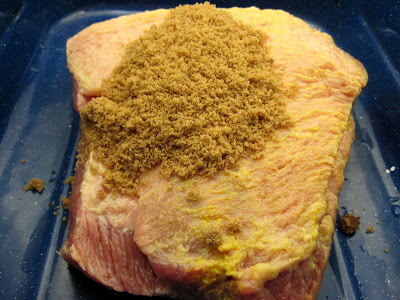
Afterwards, I used 3 T of brown sugar.


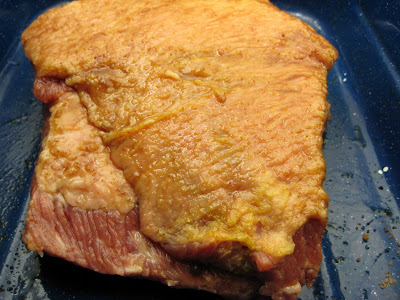
The brown sugar is rubbed into all surfaces of the corned beef. The sugar gives a little sweetness and helps with browning. Of course you can use more sugar, but I tend to use less since I'm not looking for a heavy glaze as you would with a ham.


This is my first time using Guinness. I was looking in the fridge and found an old bottle of Guinness. Usually when I bake corned beef, I don't add any liquid but I wanted to try something different to see if the extra liquid would help tenderize the meat.


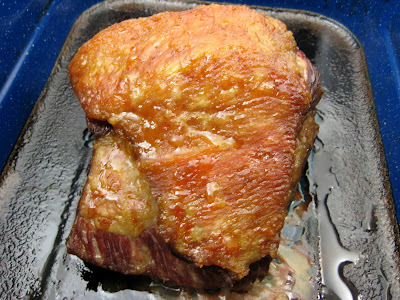
The brisket was placed in a 200F oven and allowed to cook slowly while I was at work.

Driving to work, I was amazed that there was snow on the road. This is more snow than we had during winter.


After 7 hours, the corned beef was taken out of the oven.


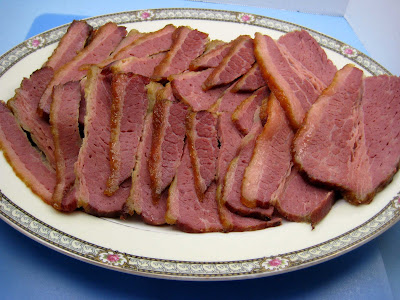
After a 10-15 minute rest, the corned beef was sliced.


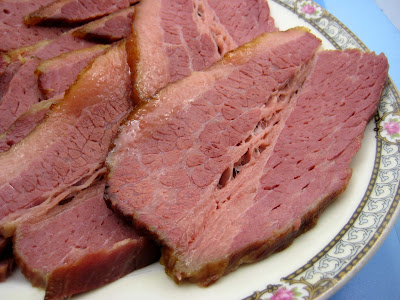
Overall, the beef was good. Reminded me of deli counter lunch meat, but not as salty as luncheon meat. Also, no strong taste of pickling spice as you would get from boiling. The corned beef was firmer than a boiled corned beef.

I don't think the Guinness made a difference in flavor and the extra liquid did not change the texture of the slow roasted corned beef. Maybe the extra liquid helped draw out salt, but Costco corned beefs are generally more flavorful while less salty.

Saturday, March 22, 2008

Corned Beef Hash

I had some leftover corned beef and roasted potatoes so I decided to make corned beef hash. When I go out for breakfast, corned beef hash or biscuits and gravy are my two must tries at a restaurant, but not at the same seating. lol :-P

The Fixins'
3/4 C roasted potatoes, coarse chop
3/4 C corned beef, coarse chop
2 T onion, coarse chop
1 T bell pepper, coarse chop
1.2 T parsley
1/4 t garlic powder
Pinch of tarragon
Pinch of thyme

Of course, being a guy I have to use every dish, pot and pan, plus pull out appliances to make this dish.

I typically just chop and fry, but this time I wanted to try a finer mince so I dumped all of the ingredients into the mini food processor and gave it a few pulses.


The ingredients after a few pulses. This looked good to me. I didn't want a mash. The mixture at this point looked a little dry, but I continued on.


Pan frying the corned beef hash in a canola oil/butter mixture, about 1 T (T = Tablespoon).
I remember watching the show, Good Eats, and Alton Brown used a weight to cook his corned beef hash recipe. I believe the weight acts to increase the contact area and help brown the hash, similar to a bacon press. I used a sauce pan filled with water as the weight. Pot #2. :-)


The hash did not flip as a pancake, but turned out crumbly. I also poached a couple eggs as a topper.

Corned beef hash topped with two poached eggs and a sprinkle of cayenne pepper.
I got a little distracted and didn't flip the hash sooner. The crispy bits are a little dark. :-)


The Final Dish
Corned beef hash, poached eggs served with a buttered English muffin. Instead of Hollandaise sauce, ketchup and Louisiana style hot sauce was used.


Overall, the dish had good flavor but was a little dry and crumbly. I was hoping for something a little more moist and cohesive.

Corned beef hash was originally based upon leftovers. I had some cabbage and carrots from the St. Patrick's Day meal, but didn't want that in this dish. However, those veggies would have added extra moisture to the dish. Also, the roasted potatoes I did use are drier than boiled potatoes.

Next time boiled potatoes will be used and that should increase the moistness of the dish. Also, increasing the veggies a little - onions, bell pepper, fresh garlic and parsley, will help too. Finally, a little broth can be added to increase moisture and flavor.

Final utensil count
Pot and Pan Count: 3 (Frying pan, weight pan and poached egg pot)
Appliance: Food processor
Other: Cutting board, knife, slotted spoon, spatula

Not bad for a simple breakfast. lol!

Monday, March 17, 2008

Happy St. Patrick's Day!

Today, everyone is a little bit Irish.
The traditional dinner in the USA used to celebrate St. Patrick's Day is corned beef and cabbage.

A couple years ago I made my own corned beef from scratch. It turned out very good with more flavor than the store bought corned beef. However, I didn't have the time to make one from scratch so I bought one from Costco. I like the one's from Costco. They don't seem as salty as the inexpensive on-sale corned beef at the local supermarket.

Cooking is simple
Put the brisket in a big pot of water and boil/simmer for 2 to 2.5 hours.

Cabbage - some people like to boil separately, but I like to add the cabbage the last 15 minutes (sooner or later for desired tenderness) into the corned beef liquid. The same with the carrots.

Potatoes - Boiled with the corned beef the first 30 minutes. Afterwards, I removed the potatoes from the liquid, cut them into cubes. Added salt, pepper and some chopped onions. Coated with olive oil and a couple pats of butter.
Finally, I roasted the potatoes in the oven 375 F for the last 30 minutes.
By roasting, I wanted some add texture to the meal instead of having a fully boiled mushy meal.

The Final Dish
Sliced corned beef, a wedge of cabbage, carrots, roasted potatoes, rustic olive bread I found at the supermarket and a dollop of horseradish to add a little kick.
Overall a simple meal to prepare where the brisket was very moist and not too salty.