An Experiment?
Yep, a cooking experiment. :-)
I've always wondered how Chinese restaurant tenderize the meat used in beef dishes. You know, the beef that's so tender that it seems to melt in your mouth and where the beef has a strangely unnatural squishy texture.
Is it meat tenderizer? Is it the cut of beef? Is it the cooking method?
However, today, I scaled back the experiment. The weather was much cooler so I worked on the backyard and cleaning the carpets in the house. I'm a tired boy! lol.
Also, I bought a digital probe thermometer so I wanted to try it out on the beef roast. Gotta try out the new gadget!
I did reserve a little beef for the Chinese beef experiment.
Doing some online research some sites suggest using baking soda. Also, my sister-in-law concurred that baking soda is used in Chinese beef dishes.
I'm actually skeptical about baking soda tenderizing beef.
My quick experiment - most of this was done by estimating - nothing was weighed or measured.
1. Thinly slice the beef and mix: The idea of mixing is to randomize the pieces so any bias with which end the piece was cut from is reduced.
2. Divide into two samples - a control batch and a baking soda batch. The batches were about the size of an egg when held in my hand.
3. Add baking soda to one batch - approximately 1/4 teaspoon.
4. Wait 10 minutes.
5. Rinse the baking soda beef to ensure the baking soda is washed out.
6. Rinse the control beef so both batches go through the same process.
7. Dry
8. Heat up a frying pan at medium high. Wait 1 minute add 1 tsp oil. Wait another minute before cooking the control batch. No salt or other seasonings. Just canola oil.
9. Wash pan and repeat step 8 for the baking soda batch.
10. Allow beef to cool before sampling.
Observations:
1. When I was rinsing the beef, there was definite difference between the two. The baking soda beef was smoother to the touch while the control felt like wet beef, a little coarse.
2. I noticed the baking soda batch had thinner slices. I guess I didn't mix enough.
Left - Baking soda treated beef
Right - Control

Tasting:
1. Surprisingly, the baking soda batch was more tender than the control batch.
2. The baking soda batch doesn't have the beefy taste while the control batch still taste like beef.
The baking soda does tenderize the beef, but it seems you sacrifice the beef flavor. However, in Chinese dishes with strong sauces, I guess the sauces make up for the lack of beefy flavors.
How does the baking soda tenderize the beef?
I don't know.
However, I can understand the slick feeling when I was washing the beef.
Baking soda is an alkali... that reacts with the fat to make soap.
The geek word for today is "Saponification".
I think I'll try this experiment again, but the next time around I'll try to measure and weigh things out. Also, I'll try different amounts of baking soda and varying "soak" times before rinsing.
Part 2: The new gadget
The Roast Beef - using the digital probe thermometer.
Beef Roast - Top Round Roast for today.
1 Tablespoon Suzy-Q
Bake 350F until desired doneness is achieved.
My goal was medium-rare at 145F internal temperature.

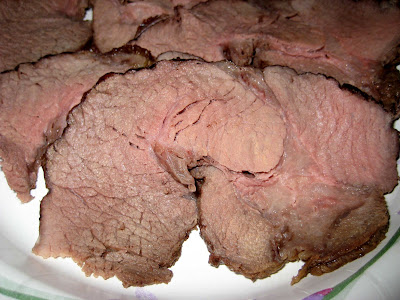
Note to self... Read instructions. I forgot to turn on the beeper. By the time I checked the thermometer the beef was at 150F. After resting it peaked at 157F.
Sliced roast beef - medium. A bit too done for my liking. The problem with roasting a less tender cut of beef. It really should go above medium-rare if you want something less chewy.
One thing I am confused about. The thermometer's control unit comes preset with a temperature target for the meat being cooked and desired doneness.
For beef, the instructions list medium-rare as 145F to 159F. I could have sworn medium-rare was 130F to 140F. The temperature the roast max'd out at was 157F which to me is medium-well, not medium-rare. I need to look into this.


