The Academy Awards are just around the corner. That means people are gearing up for an Oscar party!
Here's an appetizer that's easy to make and requires only two ingredients, plus dipping sauces if you like.
Easy Pigs in a Blanket
1 - 8 oz can of refrigerated crescent dinner rolls (e.g. Pillsbury)
1 - 13 oz package of mini-size smoked link sausages (e.g. Little Smokies)
The sausages are cooked so you're just cooking the crescent roll.
My YouTube Video: Channel eat4f1
1) Separate the crescent rolls into triangles (usually 8 per tube). Cut each triangle into thirds.
2) Roll the dough around the sausage - starting at the wide end and working towards the narrow end.
3) Depending upon the website
Pillsbury recommends baking 375F for 12 to 15 minutes while Hilshire Farms recommends 400F for 9 to 10 minutes. I tried both temperatures and both worked.
The key is to bake until golden brown which worked out to 375F for 13 minutes and 400 F for 11 minutes.
Finished results - Golden brown top and bottom.
Can be eaten as is or with a dipping sauce, such as, ketchup, mustard, ranch dressing or blue cheese dressing. No rules here. It's a party! Par-tay!
Our May hostess, Denise, of There’s a Newf in My Soup!, challenged The Daring Cooks to make Gumbo! She provided us with all the recipes we’d need, from creole spices, homemade stock, and Louisiana white rice, to Drew’s Chicken & Smoked Sausage Gumbo and Seafood Gumbo from My New Orleans: The Cookbook, by John Besh.
[Eat4Fun: When I lived in New Orleans, gumbo was delicious comfort food that everyone could make, even the cafeteria at work made good gumbo.
For this challenge, I picked the Chicken and Smoked Sausage Gumbo recipe.]
Recipe Source: The recipes for Drew’s Chicken & Smoked Sausage Gumbo and Seafood Gumbo, as well as the stocks, Creole spices, and rice, are from My New Orleans: The Cookbook, by John Besh (Andrews McMeel Publishing, October 2009).
Notes from Denise: Roux. Crucial to the gumbo is the roux. According to Besh, there are other thickeners besides flour for making their roux, but only a flour-based roux yields that traditional flavor. As for the fats in a roux, just about anything works. Rendered duck fat, chicken fat, or lard is preferred, but canola oil works nearly as well. Use a 1:1 ratio of flour to fat/oil. Heat the oil first and whisk the flour into the hot oil. This speeds up the process and yields a deep, dark chocolate-colored gumbo. Always add the onions first to the dark roux, holding back the rest of the vegetables until the onion caramelizes. Otherwise, the water in the vegetables will keep the onion from browning and releasing its sweet juices. Chef Link stresses that it’s essential to whisk the roux constantly as it cooks (but not so vigorously that you splatter the roux and burn yourself), because if even a small bit of flour sticks to the pot, it will become spotty, scorch quickly, and burn the entire roux. Also, Link advises against using a wooden spoon to stir the roux, until after the onions are added. A whisk allows the roux to pass through it and reduces the possibility of splashing, as well as getting into the sides of the pan.
Holy Trinity. As a culinary term, Wikipedia tells us the holy trinity originally refers specifically to chopped onions, bell peppers (capsicums), and celery, combined in a rough ratio of 1:2:3 and used as the staple base for much of the cooking in the Cajun and Louisiana Creole regional cuisines of the state of Louisiana, USA. The preparation of classic Cajun/Creole dishes such étouffée, gumbo, and jambalaya all start from the base of this holy trinity. Similar combinations of vegetables are known as mirepoix in French cooking, refogado in Portuguese, soffritto in Italian, and sofrito in Spanish. While a "trinity" may refer to a generic representation of three cornerstone ingredients of a particular national cuisine, a trio of specific ingredients combined together to become essentially flavor bases, much like its original usage within Louisiana cuisine, are also called "trinities". This is often created by sautéing a combination of any three (or at least, the primary three ingredients in a more complex base) aromatic vegetables, condiments, seasonings, herbs, or spices.
Okra. These delicately ridged and tapered green pods, sometimes called Ladies’ fingers, are a member of the mallow family and are bursting with tiny seeds as well as the glutinous compounds that make okra such a natural thickener for soups and gumbos. When buying okra, look for smaller, greener spears. I was able to find fresh okra at Whole Foods. Good frozen okra will also work fine, especially if it’s pre-sliced. In addition to adding it to both gumbos, I deep-fried some okra for garnish on top of the Seafood Gumbo (sliced into ½ inch (15mm) thick slices, dipped in buttermilk, dusted in a mixture of equal parts cornmeal and flour, fried a few minutes until golden, and seasoned with Creole Spices).
Filé powder. Besh tells us filé has been a vital ingredient in Creole gumbo since the mid-1800s, when Choctaw Indians traveled in from communities on Lake Pontchartrain to sell it at the New Orleans French Market, along with bay leaves and handmade baskets. The Choctaws make filé by drying, then finely pounding, the leaves of the sassafras tree into a powder, then passing it through a hair sieve. The leaves, in the form of filé powder, contribute a unique and spicy note to gumbo. Originally, filé was used to thicken the stew when okra was not available, but he likes to use both. He cooks the okra in the gumbo and adds a couple dashes of filé, too, at the end. He also likes to pass filé at the table as a seasoning. The word comes from the French word filer, meaning, “to spin thread,” which is a warning not to add filé while the gumbo is still boiling, as it has a tendency to turn stringy. See link under Additional Information, below, for making your own filé.
Chicken. Drew’s Chicken & Smoked Sausage Gumbo calls for a whole chicken, cut up into 10 pieces. The bones and skin obviously add vital flavor throughout the cooking, especially if you’re using canned broth rather than homemade stock. However, once the chicken was cooked and the meat was ready to fall off the bone, after about 45-60 minutes, I removed the chicken from the gumbo, took the meat off the bones, and discarded the skin and bones. I then tore the chicken into bite-size pieces and returned it to the pot for the remaining 30 minutes. This was a personal preference, and mainly because some of the smaller bones were about to break loose into the gumbo and also because the chicken didn’t really brown well initially when put into the pot with the roux and onions. If you want to leave chicken pieces in the gumbo for serving, bones and all, I would suggest browning the chicken in a separate pot before adding it to the onion-roux mixture.
Shellfish. Gumbo crabs are small blue crabs that have been cleaned and halved or quartered. They are served in the shell, and you pick out the meat as you eat the gumbo. They’re available frozen, usually in 1-pound packages. Ask your fishmonger to get you some if you can’t find them in your grocery, or you can order them online. Fresh or pasteurized lump crabmeat is a reasonable alternative. Do not use shredded or imitation crabmeat. Like the chicken bones in the Chicken and Smoked Sausage Gumbo, these add flavor to the gumbo. I omitted the gumbo crabs and used the 8 ounces (225 grams) of lump crabmeat at the end, plus a few more shrimp (prawns) and oysters. Watch your timing when adding the shellfish at the end to avoid overcooking (add no more than 15 minutes prior to serving the gumbo)!
Sausage. Drew’s Chicken & Smoked Sausage Gumbo calls for 2 pounds (1 kilogram) spicy smoked sausage, cut into slices, and 6 ounces (175 grams) andouille sausage, chopped. I’m not sure what type of spicy smoked sausage to recommend. The andouille we found was pretty spicy, and we also used some Hot Louisiana-Brand Smoked Sausage we found at Whole Foods.
Mandatory Items: Prepare a pot of gumbo, using one of the recipes provided, a variation thereof, or any other gumbo recipe you find that tickles your fancy.
Drew’s Chicken & Smoked Sausage Gumbo Minimally adapted from My New Orleans: The Cookbook, by John Besh Serves 10-12
Ingredients 1 cup (240 ml) (230 gm) rendered chicken fat, duck fat, or canola oil 1 cup (240 ml) (140 gm) (5 oz) flour 2 large onions, diced 1 chicken (3 ½ to 4 lbs.), cut into 10 pieces [I cheated here and used a rotisserie chicken.] 2 tablespoons (30 ml) (15 gm) (½ oz) Basic Creole Spices (recipe follows), or store-bought Creole spice blend 2 pounds (2 kilograms) spicy smoked sausage, sliced ½ inch (15mm) thick [I could not find andouille so I used 1 lb of hot links and 1 lb of smoked kielbasa] 2 stalks celery, diced 2 green bell peppers (capsicum), seeded and diced 1 tomato, seeded and chopped 2 cloves garlic, minced Leaves from 2 sprigs of fresh thyme 3 quarts (3 liters) Basic Chicken Stock (recipe follows), or canned chicken stock 2 bay leaves 6 ounces (175 gm) andouille sausage, chopped [I could not find andouille so I used 1 lb of hot links] 2 cups (480 ml) (320 gm) (11 oz) sliced fresh okra, ½ -inch (15mm) thick slices (or frozen, if fresh is not available) 1 tablespoon (15 ml) Worcestershire sauce Salt, to taste Freshly ground black pepper, to taste Filé powder, to taste Tabasco, to taste 4-6 cups (1 – 1½ liters) (650 gm – 950 gm) cooked Basic Louisiana White Rice [From my recollection, gumbo was served with plain white rice, which is what I made.]
Directions:
1. Prepare homemade chicken stock, if using (recipe below).
2. Prepare homemade Basic Creole Spices, if using (recipe below).
3. Season the chicken pieces with about 2 tablespoons of the Creole Spices while you prepare the vegetables.
4. Make sure all of your vegetables are cut, diced, chopped, minced and ready to go before beginning the roux. You must stand at the stove and stir the roux continuously to prevent it from burning.
5. In a large cast-iron or heavy-bottomed pan, heat the chicken fat, duck fat, or canola oil over high heat. Whisk the flour into the hot oil – it will start to sizzle. Reduce the heat to moderate, and continue whisking until the roux becomes deep brown in color, about 15 minutes.
6. Add the onions. Switch to a wooden spoon and stir the onions into the roux. Reduce the heat to medium-low. Continue stirring until the roux becomes a glossy dark brown, about 10 minutes.
7. Add the chicken to the pot; raise the heat to moderate, and cook, turning the pieces until slightly browned, about 10 minutes.
8. Add the sliced smoked sausage and stir for about a minute.
9. Add the celery, bell peppers, tomato, and garlic, and continue stirring for about 3 minutes.
10. Add the thyme, chicken stock, and bay leaves. Bring the gumbo to a boil, stirring occasionally.
11. Reduce the heat to medium-low and simmer, uncovered, for 45 minutes. Stir occasionally, skimming off the fat from the surface of the gumbo every so often.
12. Add the chopped andouille, okra, and Worcestershire. Season with salt and pepper, several dashes of filé powder, and Tabasco, all to taste.
13. Simmer for another 45 minutes, continuing to skim the fat from the surface of the gumbo. Remove the bay leaves and serve in bowls over rice. Pass more filé powder at the table if desired.
[The finished Gumbo served over rice and accompanied by buttered bread (for sopping up the extra sauce) and a salad dressed with a vinaigrette (to provide a little crunch and sourness).]
[For dessert, I made a bread pudding with rum sauce. I didn't have any bourbon. :-) ]
Jambalaya is a rice dish that's synonymous with New Orleans. According to Wikipedia, the origins is based upon paella... makes sense to me.
Jambalaya - based upon what I have locally. 1 C Onion, chopped 1/2 C Celery, chopped 1/2 C Bell Pepper, chopped 2 Clove Garlic, minced 1 Bay leaf 1/2 t Thyme 1/4 t Basil 1/4 t Cayenne Pepper 7 oz Smoked Sausage, cut into rounds 7 oz Ham, cubed 1/2 lb Shrimp, peeled and deveined 14 oz Diced Tomato, I used Italian style. 1 1/2 C Rice (I used converted rice which is very popular in New Orleans) 2 C Stock (I added the shrimp shells to further flavor the stock)
The aromatics - bell pepper, garlic, celery, onion, thyme, bay, basil and cayenne.
Sausage, ham and peeled shrimp sprinkled with Cajun seasoning.
1. Saute the onion, bell pepper, garlic and celery in a little oil (about 5 minutes) to soften the veg. Add the sausage and ham, plus the dried herb... Cook about 5 to 10 minutes.
2. Add the canned tomatoes and simmer for about 5 minutes so the flavors meld.
3. Add the rice and the stock.
3a. Added Stock. The stock was 2 cups of chicken bouillon and the shell from the shrimp. Brought to a boil and simmered for 5. Taken off the heat and allowed to steep. Strain before using.
4. The rice was cooked on medium for 2o minutes... After which the shrimp was added to the rice and allowed to steam for 10 minutes before mixing in.
The Finished Dish Served on a platter and garnished with green onions.
I remember one of my first lunches with my coworkers. We went to a local poor boy joint where I ordered a hot sausage sandwich. My expectation was a hot link sandwich, but as I learned from my stay in NOLA. New Orleans has a unique cuisine different from the rest of the South.
The sandwich came with a flavorful spicy pork sausage patty. This is my attempt to recreate the sausage.
Hot Sausage 1 lb Ground Pork 1 t Cajun Seasoning 1/2 t Garlic Powder 1/2 t Onion Powder 1/2 t Cayenne 1/2 t Chili Flakes 1/2 t Thyme
The secret ingredient? One of my favorite seasoned salts.
The rest of the ingredients...
Mixed in a ziploc bag... I'm too good to get my hands. Refrigerate overnight so he flavors meld.
Next day... two 4 ounce patties. Mashed using plates.
Cooked in the GFG for 7 minutes.
Ah... nicely browned.
For my sandwich, dressed with mayo, mustard, lettuce and tomato. With all the filling it was a 3" high sandwich.
The sausage was a little dense, but surprisingly spicy with only 1/2 t cayenne and 1/2 t chile flakes. The flavor was good, but seemed lacking from what I remember.
Notes for next time... Try a coarser grind with a higher fat content. Form the patty gentler. For more flavor, use fresh garlic and onion.
When I was researching the Internet about growing beets, many websites commented that beet greens are edible and a good source of vitamins.
Now that I've harvested the beets, I kept the greens to see how they tasted.
Also, I've been craving pasta and had some chicken sausage that needed to be eaten.
Pasta with beet greens and sausage
The Fixins' A bunch of beet greens A package of Chicken Sausage Salt Pasta Garlic Red Pepper Flakes Balsamic Vinegar
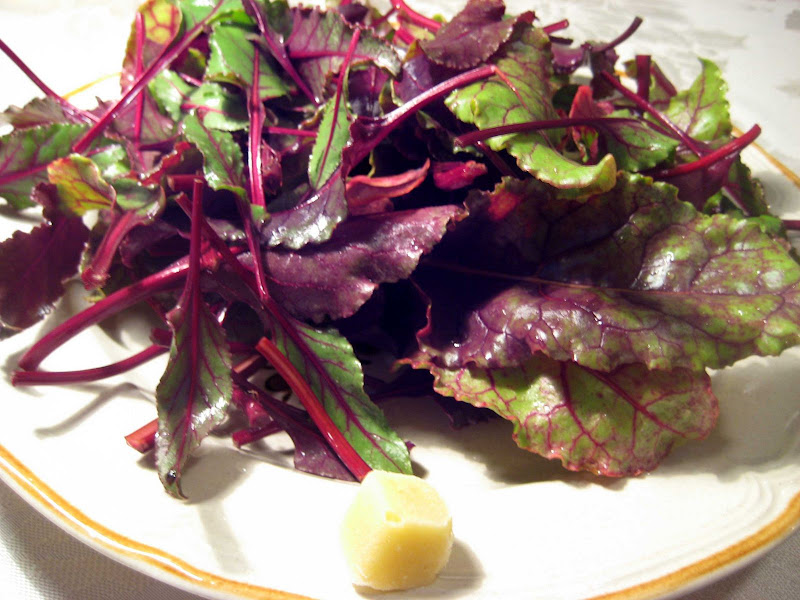
A big plate full of beet greens and a cube of frozen chopped garlic (courtesy of Trader Joe's). :-)
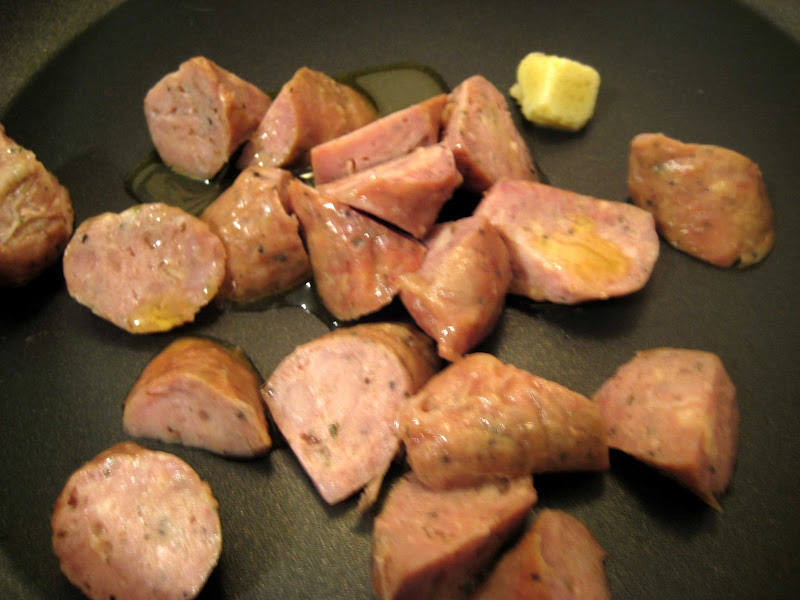
The sausage was fully cooked, but I still sauteed in olive oil and garlic. After a minute, I added the beet greens and some salt to cook down (about 10 minutes).
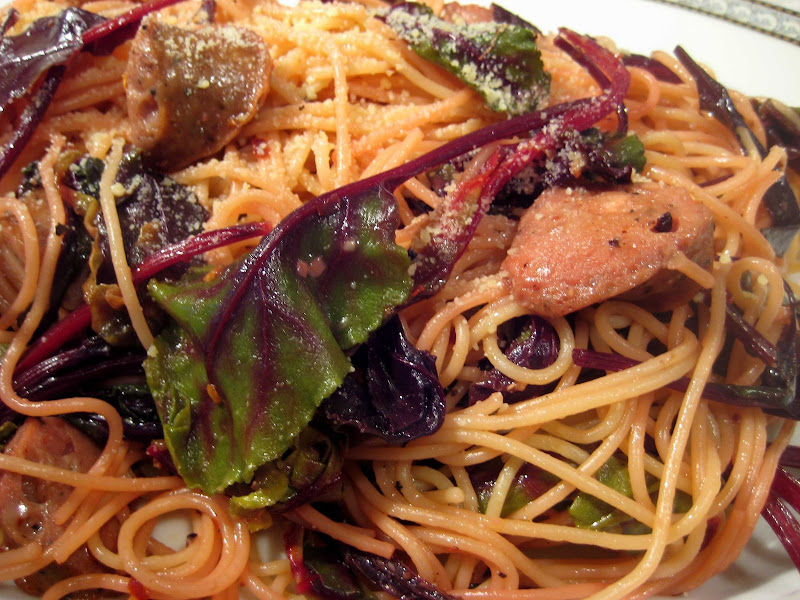
Tossed in the pasta, drizzled in a little balsamic vinegar and mixed. Garnished with red pepper flakes and Parmesan.
The beet green had a texture similar to kale - a little chewy, not as tender as spinach. The flavor was slightly sweet, but nothing really strong.
Overall, I enjoyed the dish and the pasta appeased my craving.
A flavorful breakfast sausage is the key to making good Sawmill Gravy (aka sausage gravy).
There are many contenders but few will make the grade.
Today, we have three contenders. All mild breakfast sausage. John Morrell Farmland Independent Meat Co.
I'm the commentator, cook, judge and chairman for this tasting. We're ready to start. Allez! Cuisinez!
The packages quickly are opened. 74 grams are weighed out from each roll. They're formed into rectangular patties, 3.5" by 4". The George Foreman Grill (GFG) is plugged in and preheating.
Here's a closer look at the challengers.
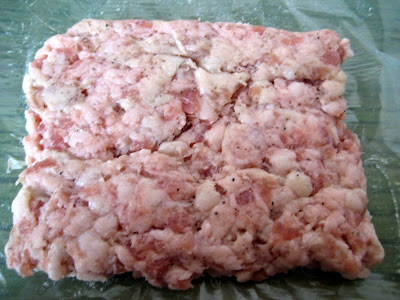
John Morrell A very dense pork product that didn't roll out easily. Looking that the patty, you can see solid little cubes of pork fat and appears to be a coarser grind of pork.
Farmland Softer sausage that rolled out quite easily. The pork is ground finely.
Independent Meat Company This product was also very easy to roll. Also, the one appeared to have a lower percentage of pork fat. You can actually see pork. The other two brands made patties were virtually white due to the higher pork fat content when compared to this patty.
Each patty was cooked individually in a preheated GFG for 4.5 minutes.
Before the next patty was cooked, the GFG was cleaned with a wet towel to remove any residual crispy bits and grease. A minutes was allotted to allow the GFG to come back to temperature.
After cooking the patties were allowed to cool. Each cooled cooked patty was weighed to see how much was cooked out. Surprisingly, each cooked patty weighed the same, 46 grams.
The sausage patties were served as part of a breakfast. No gravy.... so sad... no milk.
The Tasting The patties were tasted as is and tasted again with the eggs and biscuits, as part of a typical breakfast.
John Morrell Taste: Not a strong sausage flavor. Mainly taste salt. Texture: The crust that formed on the outside is nice and golden. Crispy, as if deep fried. I believe enough pork fat rendered out around the patty to give it a deep fried crust. Although the patty was difficult to form, the cooked patty has a soft, crumbly texture. You can feel the coarse ground pork as you chew.
Farmland Taste: A slight sausage flavor. You can taste the pork. Texture: The patty is firm, but rather juicy. The crust is typical of pan-frying.
Independent Meat Co. Taste: A better sausage flavor of the three. Texture: A firm patty, slightly drier and dense. The crust is darker than the other patties. Higher sugar content in the seasoning mix?
The Winner Each sausage seemed to have it's pros and cons. Enjoyed the texture and the coarse grind of the John Morrell. The Farmland had a cleaner flavor, but ultimately I pick Independent Meat Co. due to the better, stronger breakfast sausage flavor.
Thanks for reading... There will be another battle in the future. I have to include Jimmy Dean into the tasting.
On a previous shopping trip, I found sausage gravy in a can! Like the Loch Ness Monster and Bigfoot, I've heard of this mythical product, but haven't spied the can until recently.
My plan for today was to take advantage of three days of sunshine and warm weather to work on the backyard. To fuel up for the day's chores, this would be a good time to try the gravy.
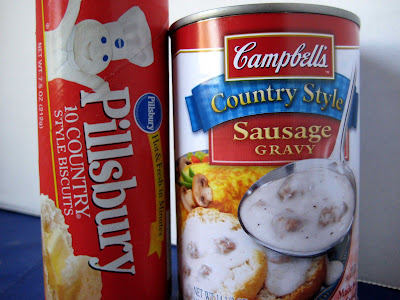
Canned biscuits and sausage gravy from Campbell's. Instructions are very simple: Heat, stirring occasionally.
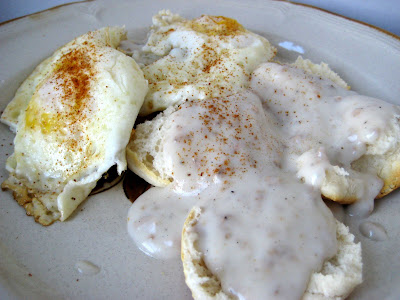
The Final Dish: Biscuits and sausage gravy with two fried eggs over easy.
The gravy has an initial taste of sausage, for a brief second, but then the saltiness overpowers taste buds. The little sausage bits have a weird squishy texture. From all of the processing?
This product would probably make a good basis for a larger casserole-type dish, like the other Campbell's "Cream of" soups. For serving on biscuits, maybe adding milk to the gravy would help cut down on the sodium.
The rest of the day... After running errands around town, the temperature was 93F when I returned home, which is much too hot for working in the backyard.
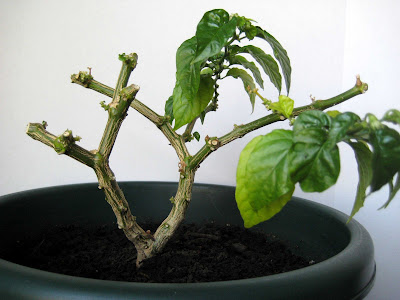
I was able to replant a habanero plant I keep at work. After three years and many inadvertent attempts to kill it, the plant bounced back each time and did well. However, now it's pot-bound to the point where the leaves are dropping. This called for some drastic measures. Massive pruning on the top from 3 ft span down to 10" inches. Trimmed and cutout 50% of the roots. We'll see if the plant bounces back after a drastic root and leaf pruning.
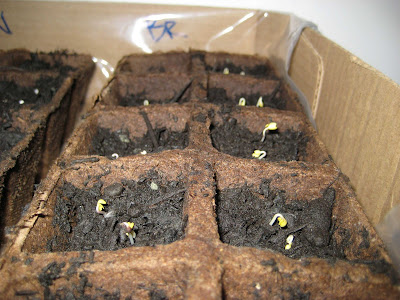
Took a look the seeds from a couple days ago... The brussels sprouts have sprouted. Wow! Germinated really quickly. No germination from the basil and sunflowers.
When we eat out for breakfast, I generally order biscuits and gravy. My goal is to find a place with good Southern biscuits and flavorful sausage gravy. We've found some places with good biscuits and gravy, but not an outstanding "I gotta go there every week" type place.
My theory is that you need start out with good sausage. However, there's not much to choose from locally. The typical brand, Jimmy Dean, to me is kind of bland. This after many attempts to make a flavorful sausage gravy. Bacon gravy I can do. Sausage gravy has been more elusive.
I found another brand (Independent Meat Co. - Mild) while shopping so I decided to try it out. Rather than going through the effort of making biscuits and gravy, I decided to make a sandwich so I can taste the sausage first.
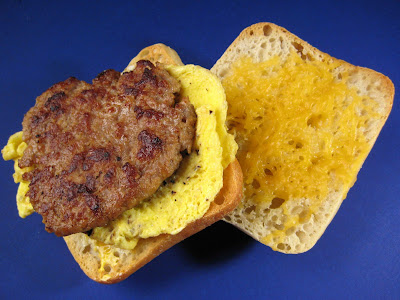
The fixins: Toasted, buttered Ciabatta bread Shredded Cheddar Scrambled eggs Sausage Patty A little mustard and mayonnaise
Assembled and Cut
The sausage had a weak sausage taste. My search continues. I did find another brand, Farmland. Farmland is a national brand so I have high hopes about the next package.