Showing posts with label noodles. Show all posts

Monday, February 14, 2011

February 14, 2011: Daring Cooks Tempura and Soba

The February 2011 Daring Cooks’ challenge was hosted by Lisa of Blueberry Girl. She challenged Daring Cooks to make Hiyashi Soba and Tempura. She has various sources for her challenge including japanesefood.about.com, pinkbites.com, and itsybitsyfoodies.com

Tempura is a Japanese dish of seafood or vegetables that have been battered and deep fried. A light batter is made of cold water (sometimes sparkling water is used to keep the batter light and soft wheat flour (cake, pastry or all-purpose flour). Eggs, baking soda or baking powder, starch, oil, and/or spices may also be added.

[Eat4Fun]: My video on making Tempura...


Soba is a type of thin Japanese noodle made from buckwheat flour. It is served either chilled with a dipping sauce, or in hot broth as a noodle soup. It takes three months for buckwheat to be ready for harvest, so it can be harvested four times a year, mainly in spring, summer, and autumn.

Hiyashi Soba is a popular dish in summer. It's like a noodle salad. Restaurants in Japan serve Hiyashi Soba only in summer. Even if you don't have much appetite because of the heat, Hiyashi Soba can be appetizing. Common Hiyashi Soba toppings are omelet strips, ham, cucumber and grated Daikon. You can also have the noodles just with the dipping sauce.

Recipe Source: Lisa had many different versions of this dish so she combined a few different recipes from around the WWW. Most notably: Zaru Soba Noodles from About.com-Japanese Food; Zaru Soba from Globetrotter Diaries; Perfect Tempura from Pink Bites; Tempura from Itsy Bitsy Foodies; and her Japanese stepmother.

Note: The most important thing is not to overcook your noodles, or you will end up with a gelatinous mass. Have a bowl of cold water and ice standing by, and once you have drained and rinsed your soba place it in the water. The great thing is once that’s done you can leave it in the fridge for up to a couple of hours and it will still be nice and fresh. Take your time and complete each step all of these items work well prepared beforehand, so don’t rush.

Mentsuyu - Traditional dipping sauce:

Ingredients
2 cups (480ml) Kombu and Katsuobushi dashi (This can be bought in many forms from most Asian stores and you can make your own. Recipe is HERE.) Or a basic vegetable stock.
1/3 cup (80 ml) soy sauce or a low sodium soy sauce
1/3 cup (80 ml) mirin (sweet rice wine)

Directions:

1. Put mirin in a sauce pan and heat gently. Add soy sauce and dashi soup stock in the pan and bring to a boil. Take off the heat and cool. Refrigerate until ready to use.

Tempura
Ingredients
1 egg yolk from a large egg
1 cup (240 ml) iced water
½ cup (120 ml) (70 gm) (2½ oz) plain (all purpose) flour, plus extra for dredging
½ cup (120 ml) (70 gm) (2½ oz) cornflour (also called cornstarch)
½ teaspoon (2½ ml) (2½ gm) (0.09 oz) baking powder
oil, for deep frying preferably vegetable
ice water bath, for the tempura batter (a larger bowl than what will be used for the tempura should be used. Fill the large bowl with ice and some water, set aside)

Very cold vegetables and seafood of your choice ie:

* Sweet potato, peeled, thinly sliced, blanched
* Carrot, peeled, thinly sliced diagonally
* Pumpkin, peeled, seeds removed, thinly sliced blanched
* Green beans, trimmed
* Green bell pepper/capsicum, seeds removed, cut into 2cm (¾ inch)-wide strips
* Assorted fresh mushrooms
* Eggplant cut into strips (traditionally it’s fanned)
* Onions sliced

Directions:

1. Place the iced water into a mixing bowl. Lightly beat the egg yolk and gradually pour into the iced water, stirring (preferably with chopsticks) and blending well. Add flours and baking powder all at once, stroke a few times with chopsticks until the ingredients are loosely combined. The batter should be runny and lumpy. Place the bowl of batter in an ice water bath to keep it cold while you are frying the tempura. The batter as well as the vegetables and seafood have to be very cold. The temperature shock between the hot oil and the cold veggies help create a crispy tempura.
2. Heat the oil in a large pan or a wok. For vegetables, the oil should be 320°F/160°C; for seafood it should be 340°F/170°C. It is more difficult to maintain a steady temperature and produce consistent tempura if you don’t have a thermometer, but it can be done. You can test the oil by dropping a piece of batter into the hot oil. If it sinks a little bit and then immediately rises to the top, the oil is ready.
3. Start with the vegetables, such as sweet potatoes, that won’t leave a strong odor in the oil. Dip them in a shallow bowl of flour to lightly coat them and then dip them into the batter. Slide them into the hot oil, deep frying only a couple of pieces at a time so that the temperature of the oil does not drop.
4. Place finished tempura pieces on a wire rack so that excess oil can drip off. Continue frying the other items, frequently scooping out any bits of batter to keep the oil clean and prevent the oil (and the remaining tempura) from getting a burned flavor.
5. Serve immediately for the best flavor, but they can also be eaten cold.

Tuesday, August 24, 2010

Aug 24, 2010: Quick and Easy Tuna Noodle Casserole

Here's a simple recipe that can be done quickly with what veggies you want. It's something that can be thrown together.

Tuna Noodle Casserole

8 oz Elbow Macaroni - aiming for 4 servings
10.5 oz can Cream of Mushroom Soup
7 oz can of Albacore Tuna, drained and mashed
1/2 Onion, chopped
1 Stalk Celery, chopped
1 Stalk Broccoli, peeled and chopped... Using every bit while the florets were steamed as a side dish.
3/4 C Frozen Peas... I would added more if I had more.
1/2 C milk
1/2 C Sharp Cheddar, shredded
1 T Pimento... Added for color. I would have used carrots. I didn't find any.
1 T Butter

1) Cook the macaroni per instructions... toss in the frozen peas for the last minute.

2) While the mac is boiling, saute fresh veggies.

3) Add the cream of mushroom soup and milk to the veggies. Add Tuna and break up the chunks.

4) Drain the pasta and add to the soup mixture. (You can eat at this point, but being a guy I have to use another dish. lol )

5) Pour into a 8 x 8 baking dish and top with cheese... Bake 350 F until cheese melted.


Service up!


A very simple dish that turned out nicely.
Use any veggies you like.

Monday, June 21, 2010

Jan 21, 2010: LOP Dan Dan Noodles

My journey into Sichuanese cooking was brought to you via Fuchsia Dunlop's book, Land of Plenty: A Treasury of Authentic Sichuan Cooking.

In the USA, Sichuan cooking has a reputation of being mind-blowing fiery. However, based upon the recipes I've made so far I would say the recipes are comfortably spicy, but I'm a chile-head. I was half expecting more layers of flavor - salty, sweet, sour and spicy, garlicy... etc, but the recipes I tried seemed to rely on savory and spicy.

Overall, I enjoyed the dishes I tried immensely.

My final dish I plan to make is Dan Dan Noodles. Two recipes are provided in the book, the second recipe appealed to me for the use of sesame paste. I have a lot of Tahini in the fridge from a previous Daring Kitchen challenge.

That's Dan Dan noodles, not to be confused with Bam Bam Rubble, Tom Tom Club (Genius of Love) and not to be confused with Gene Gene the Dancing Machine.


However, cooking, sharing and eating is just as fun where you just want to get up and dance!


Xie Laoban's Dan Dan Noodles

Ingredients
1 lb Fresh Chinese Noodles or 12 oz Dried Chinese Noodles
1 T peanut oil
3 Sichuanese Dried Chiles, snipped in half, seeds discarded
1/2 t whole Sichuan peppercorn
2 T Sichuanese ya cai or Tianjin preserved vegetable
4 oz ground beef
2 t light soy sauce
Salt to taste

For the sauce:
1.2 - 1 t Ground roasted Sichuan pepper
1/4 t salt
4 t sesame paste
1 T light soy sauce
1 T dark soy sauce
2 T dark chili oil with chile flakes

The new ingredients added to my pantry - salted, garlicky preserved vegetable greens and chili oil. I couldn't believe how difficult finding chili oil would be. There is a recipe included in the book, but since I picked this recipe at the spur of the moment I didn't feel like making my own.


This is the preserved vegetables. The main aroma was garlic. A good thing!


Making the sauce - combining the Tanini (sesame paste) and ground peppercorns.


Combining the rest of the ingredients... the resulting sauce was pretty thick, like a chocolate ganache.


Rest of the ingredients are pretty simple.
Whole peppercorn, seeded dried chilies, ground chicken mixed with the rest of the ingredients.


Fry the chilies and peppercorns in 1T of oil until fragrant.
Add the preserved vegetables to fry about a minute
Add the ground meat and cook.
Set aside for later.


When the noodles are cooked - I used fettuccine pasta.
Mix in the sauce and top with the meat filling.


The noodles were nutty, savory with a little punch from the Sichuan peppercorns. I probably undersauced the noodles, but overall I liked the results.

Tuesday, April 6, 2010

Apr 06, 2010: Tofu Tuesday Hodge Podge

Today, is a hodge podge recipe... looking to make something quick and healthy plus I have frozen shrimp scampi in the freezer and leftover ham from Easter.

Tofu Hodge Podge
1 lbf Firm Tofu, cubed
3 Green Onions, sliced
1 Carrot, diagonal sliced
1/2 C Red Bell Pepper, diced
1 Stalk of Celery, diced
1 Clove Garlic, minced
1 C Ham, mined
Frozen Shrimp Scampi
Salt and Pepper to taste.
Egg Noodles


As usual with firm tofu, I like to pan fry with salt and pepper to brown and crisp up the tofu.


Add the rest of the ingredients, give a quick mix and cover to cook.


Serve over noodles (or rice). Salt and pepper to taste.


Quick, simple and fairly good. It's not 3-Star Michelin, but it does hit the spot.

Tuesday, March 16, 2010

Mar 16, 2010: Tofu Tuesday Allium Pork

Guess what today is? Tuesday!
What do we do on Tuesday? Cook some tofu!

I did a little pre-spring cleaning where I cleaned out the pantry and the refrigerator.
My discoveries my refrigerator had a selection of allium. Leeks, Chinese Chives, Green Onions and Garlic.

Also found was an assortment of Chinese bean sauces. Hoisin sauce, Szechuan Hot Bean Paste and plain Bean Paste.

Not one for wasting ingredients, I improvised a recipe using a portion of fresh ham and, of course, tofu.

Allium Braised Pork with Tofu
2 C Leek, coarse chop and cleaned
1 C Chinese Chives, coarse chop
1/2 C Green Onion, coarse chop
3 Cloves Garlic, smacked with a knife
4 or 5 Ginger slices
2 T Szechuan Hot Bean Paste
1 T Bean Paste
1 T Hoisin Sauce
1 Piece of Rock Sugar
1/2 C Soy Sauce, Regular
1 lb Firm Tofu, cubed
1 to 2 C of stock or water

My mise en place.
The allium. The garlic is in there somewhere hiding.


The bean sauces. The Szechuan hot bean paste (aka Chile Bean Sauce) has a pleasant level of heat with a miso-like aftertaste. This is my first time using this stuff.


Cuved Tofu... ready to go!


Directions:
1) As with a beef pot roast, I browned the pork on all sides in the dutch oven.
Remove when browned.


2) Another find in my refrigerator, about 1/2 C of diced pancetta.
Lightly cooked to release it's fat. Added the allium to sweat.


3) After sweating the alliums, the rest of the ingredients go in to mix.


4) The pork and soy sauce is added. Additional stock is used to raise the liquid level about 1/2 to 3/4 the way up the pork.


5) Finally the tofu cubes are added.


6) There are many ways to cook this dish, but the objective is to slowly simmer the mixture for a few hours. This can be done on the stove top or in the oven.

I went the oven route. The entire pot was placed in the 250F oven for 3 hours.

The results after 3 hours. The pork is falling off the bone and the tofu absorbed the flavors of the braising liquid.


Serving:
The braised pork is pulled off the bone and shredded.

Instead of rice... I'm a little burned out on rice, especially after the Risotto challenge.

I opted to serve over noodles.
The noodles are cooked and drained.
While still hot, shredded cabbage and carrots are added plus a 1/2 t of toasted sesame oil.
The residual heat will cook the shredded veggies.


The mixture is spooned over the noodles and served family style.


Bean paste has a miso-like flavoring. The hot bean paste mellowed but still had a little kick. The tofu absorbed a lot of the flavorful liquids.

This all made for a delicious meal.

Changes I would make the next time around... a little less soy sauce and more sugar.

Wednesday, March 10, 2010

Mar 10, 2010: Tuna Noodle Casserole

After a busy day, sometimes you want some good ol' comfort food. Nothing fancy and made as simple as possible. Today was just that day. The dish is Tuna Noodle Casserole.

There are many recipes and variations. This one is kept as simple and basic as possible.
Also, with this type of cooking there is a lot of ad-libbing and using what you like or what you have.

Basic Tuna Noodle Casserole
Preheat oven 350F

10 oz (dry) Noodles, cook the noodles per the package instructions
1 can of Tuna
1/2 Onion, chopped
3/4 C Peas
1 Can of Cream of Mushroom Soup
Shredded Cheese


1. Saute the onions with butter until soft.


2. Add the frozen peas and saute to defrost.
You can add any veggies you like.


3. Add the soup and tuna.
Mix to break up the tuna and combine ingredients.
Note: You can add milk or water if you like a saucier tuna noodle casserole.


4. Combine the cooked noodles and the sauce mixture in a buttered baking dish.
Note: I used 10 oz of noodles. The nutritional info stated 1 serving was 2 oz. Generally, I make one serving more. For 4 servings, I would use 5 servings (10 oz).


5. Top with Cheese. If I had more cheese, I would have mixed the cheese into the casserole.


6. Bake 350F for about 20 minutes.


The finished casserole.
Simple and hits that comfort zone. :-)

Thursday, November 20, 2008

Nov 20: Chicken a la King

I was trying to decide what to do with the leftover roasted chicken when I struck upon Chicken a la King. Chicken a la King is one of those American dishes that has fallen out of popularity... along with jello molds, Swiss steak and Mai Tai.

My first taste of Chicken a la King was probably 25 or 30 years ago at my (mom's) uncle's diner.
His diner was located in an industrial area of town beneath a high rise freeway, next to a brewery. His customers consisted of blue collar workers and well as suits.

He would occasionally call my mom to help out during seasonal rushes. I tagged along to help, if that's what it was called back in the day. I mainly remember taking potatoes and running them through a french fry maker and busing tables.

Another memory is my dad driving us to the diner for the breakfast rush and watching the sunrise from the backseat of the car. However, I think my parents wanted me out of the house since they were worried that my favorite activities were to "eat, sleep and watch TV." Little did they know that as an adult... my daily schedule is "work, eat, watch some TV, get little sleep"... and repeat.

To find a recipe, I had to dig through my cookbooks... I found a recipe in "The Complete Everyday Cookbook", Copyright 1971. Hmmm.... 1971. That sounds about right for Chicken a la King. The recipe I made is loosely based upon the recipe in the above mentioned book.

Chicken a la King
The Fixins' - starting at the top, left of the photo.

1 egg yolk, mixed with a few drops of hot sauce (Frank's Red Hot)
1/4 C peas
2 T diced Pimentos
2T Flour
1 1/4 C Chicken Broth
1/2 C Mushrooms, chopped
1 C Cooked Chicken, coarsely chopped (plus 1/2C cooked potatoes, coarsely chopped)
Chicken Fat from the roast
1/3 C Heavy Cream


Using the chicken fat (about 1 or 2 T) saute the mushrooms until soft.
Add the flour to slightly cook.
Add the broth and mix thoroughly... bring to a gentle simmer.


Add the peas, chicken, potatoes and heavy cream.
Mix and bring to a simmer to heat the ingredients and allow the sauce to thicken.
Stir and add the pimentos


After 5 minutes of simmering, slowly add the egg yolk and stir to thicken the sauce.


The books suggest serving over waffles. Waffles!?!? I don't remember that.
Instead, I served the mixture over noodles.


The taste was akin to a chicken pot pie filling. The sauce was silky smooth... which was a pleasant surprise. The dish was good, but wasn't what I remembered as Chicken a la King. I seem to recall a stronger "cooked" bell pepper flavor... from the pimentos? However, that memory is about 30 years old.

*** Update Nov 21 ****
This is the recipe from the cookbook.
"The Complete Everyday Cookbook" by Ottenheimer Publishers, Inc. 1971.

Chicken a la King
1/4 C butter or margarine
1 C sliced mushrooms
1/4 C flour
1 C Chicken Stock
1 1/2 C half and half milk
1/2 C diced pimento
3 C diced cooked chicken
2 egg yolks, slightly beaten
Salt and Pepper to taste

Heat butter in a blazer pan of chafing dish over direct heat.
Add mushrooms and cook until tender, about 5 minutes.
Stir in flour.
Add stock and half and half milk.
Place blazer pan over hot water.
Cook, stirring occasionally, until thickened and smooth.
Add pimiento and chicken.
Heat thoroughly.
Stir a little of the hot sauce into the egg yolks.
Add slowly to remaining sauce and stir, until smooth and hot.
Server over crispy waffles.
Makes 6 servings.

Note: For my recipe I added peas... and I misread the instructions about the egg yolk. I thought the recipe called for some hot sauce (as in pepper sauce) mixed into the egg yolks. I guess they orginally meant hot sauce as in the gravy to temper the yolks. :-)

Other dishes that have fallen out of favor...
Chipped beef on toast (SOS)
Poached eggs (Adam and Eve on a raft [toast])
Fondue

Monday, April 28, 2008

Apr 28: Noodles with Pork and Mushrooms

I was looking in the refrigerator and found some mushrooms I had purchased a week ago. I don't remember why I bought the mushrooms so I improvised. Also, I was craving fresh noodles.
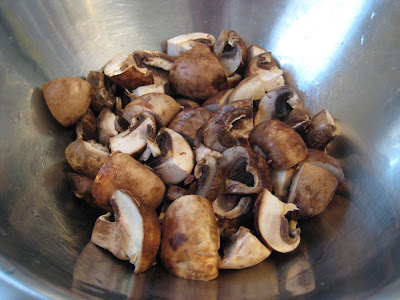
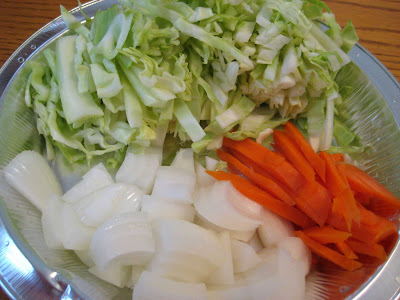
The Fixins'

3 or 4 C of mushrooms, cut into quarters
1/2 onion, 1/2" dice
1/2 C carrots, sliced thin
1 C cabbage, shredded
9 oz fresh noodles
8 oz thinly sliced pork, marinaded with a little soy, garlic, green onions and a little corn starch


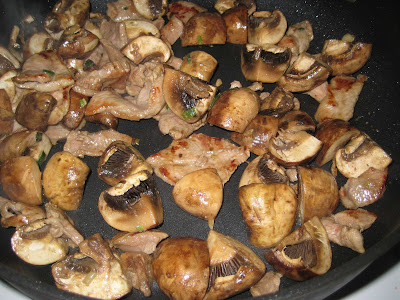
The mushrooms were washed and quartered. There was about 3 cups. I purposely left them chunky so they would add some texture.


The cabbage, carrots and onion.


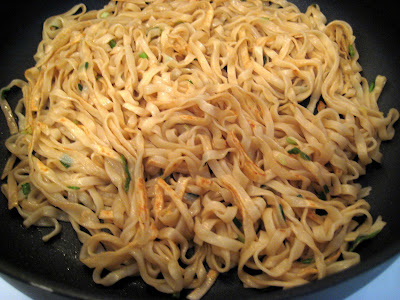
The noodles were cooked in boiling water for about 2 minutes. Drained and rinsed.

Before pan-frying, I gave the noodles a coating of soy sauce (about 1 tablespoon), some green onions (2 small, chopped), about 1 teaspoon of toasted sesame oil, a dash of garlic powder and 1/2 Tablespoon of oyster sauce. The noodles were mixed and tossed in a hot pan with oil.


I like pan-frying the noodles. The noodles crispy up slightly which adds a little extra flavor.


The noodles were set aside.

On medium-high heat, the pork was sauteed about 5 minutes before the mushrooms were added. Afterwards the rest of the veggies were added and cooked about 3 to 5 minutes.

Finally the noodles were added back to the mixture and incorporated.


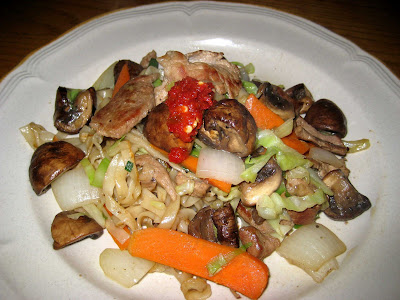
The Final Dish

The stir fried noodles were plated and topped with a spoonful of chili paste.


The dish was flavorful and the noodles were dry and flavorful. Just the way I like it. If you like your noodles and stir fry a little saucy, you can add some chicken broth and a little corn starch to form a sauce.