Dave and Linda from Monkeyshines in the Kitchen chose Soufflés as our November 2010 Daring Cooks’ Challenge! Dave and Linda provided two of their own delicious recipes plus a sinfully decadent chocolate soufflé recipe adapted from Gordon Ramsay’s recipe found at the BBC Good Food website.
There are basically two parts to a soufflé recipe: the base and the egg whites. For savory soufflés, the base is usually a thick roux-based sauce made of butter, flour and milk or stock – to which you add the flavoring ingredients and the egg yolks. Sweet soufflés are based on a crème patisserie, or thick custard. The egg whites are beaten separately so that they incorporate lots of air bubbles; then the egg whites are folded into the base and the mixture spooned into a soufflé dish. After baking in the oven, the soufflé will magically rise. However, be warned that what goes up must come down: even a perfect soufflé will start to ‘deflate’ once you remove it from the oven - so be sure to serve it (or photograph it!) as soon as possible. In fact, Dave and Linda think the photographic aspect of this project may turn out to be more difficult than the culinary part.
[Eat4fun: I've always wanted to give a go at making a souffle. Here's my chance. I'm typically a savory kind of guy, but this time around I choose the chocolate souffle.]
Chocolate Souffle Adapted From BBC Good Food Recipe by Gordon Ramsay
Ingredients
FOR THE DISHES 2 Tbsp (30 ml) 1 oz (30g) unsalted butter, for greasing Cocoa powder or finely grated chocolate
FOR THE CREME PATISSERIE 2 tbsp (30 ml) (18 gm) (2/3 oz) plain (all-purpose) flour 2 tsp (10 gm) (0.35 oz) caster (superfine) sugar (regular sugar is OK) ½ tsp (4½ gm) (0.15 oz) corn starch (aka cornflour) 1 medium egg yolk 1 medium whole egg 4 Tbsp (60 ml) milk 5 Tbsp (75 ml) heavy cream (or double cream) 3 oz (90gm) good-quality dark chocolate preferably 70+% cocoa solids, broken in pieces 2 Tbsp (30 ml) (15 gm) (½ oz) unsweetened cocoa powder Optional: 2 tsp orange zest or 2 tsp minced chipotle chile en adobo or 1 tsp chipotle chile powder. (The chile version is a Monkeyshines favorite!) Optional: powdered sugar for dusting
FOR THE EGG WHITES 6 medium egg whites 6½ Tbsp (95 ml) 3 oz (90g) superfine/caster sugar (if you don’t have it, regular sugar is OK)
Directions: 1. Heat oven to moderate 375 ˚F/190 ˚C/gas mark 5.
2. Take four 1 cup/~240ml soufflé dishes and brush them completely with softened butter. Tip a little cocoa powder or grated chocolate into each dish, roll the dish around tilting it as you do so it is evenly lined all round.
[Instead of four 1 C ramekins, I used a larger 2 quart Pyrex dish.]
3. For the crème patisserie, mix the flour, sugar and corn starch into a small bowl. Put egg yolk and whole egg into a medium sized bowl, beat lightly, then beat in half of the flour mixture to give a smooth paste. Tip in the rest of the flour mixture and cocoa powder and mix well.
[The egg yolk mixture is pretty straightforward.]
[Amazing how the cocoa powder will mix in to form this very dark high viscosity liquid.]
4. To make the ganache, pour the milk and cream into a pan and bring just to the boil. Remove from the heat. Add the chocolate and beat until it is melted and smooth with no lumps.
[Whoa! This ganache is very watery, not like any ganache I've made in the past. Hopefully, the thick egg yolk mixture will compensate for the watery ganache.]
5. Gradually stir hot chocolate ganache into the paste from step 3, and add the orange zest or chile if using. This is your crème patisserie.
6. Whisk the egg whites to soft peaks with an electric whisk. Sprinkle in the sugar as you are mixing. Keep whisking to give stiff, firm peaks to give volume to the soufflés.
[Stiff Peaks. You must have patience with whipping egg whites to stiff peaks. It takes about 5 to 10 minutes so don't give up.]
7. Stir about 2 tbsp (30 ml) of the beaten egg whites into the crème patisserie. Carefully fold in a third of the rest, cutting through the mixture. Fold in another third (take care not to lose the volume), then fold in the rest.
[Stirred in what was on the beaters plus a little more to lighten up the patisserie.]
[Adding the egg whites 1/3rd at a time.]
8. Spoon the mixture into the dishes. Run a spoon across the top of each dish so the mixture is completely flat. Take a little time to wipe any splashes off the outside of each dish, or they will burn on while cooking.
[Another trick is to wipe the edge of the dish so the mixture forms a little trench between the dish and the mixture. This is supposed to help the souffle rise in the center.]
9. Bake the soufflés for 15-17 minutes. [For a larger dish, I baked about 20 minutes and used a skewer to check for doneness. The skewer should come out clean. I ended up cooking for 30 minutes, but probably could have pulled the souffle out at 25.]
[The next three photos show the rising during cooking. Just into the 350F oven.]
[About 15 minutes into the cooking.]
[About 20 minutes into cooking. A skewer was used to test for doneness. At 20 minutes, the skewer came out wet so the souffle was allowed to bake another 10 minutes.]
10. The soufflés should have risen by about two thirds of their original height and jiggle when moved, but be set on top.
[The souffle out of the oven after 30 minutes of baking. A bit overcooked where the souffle seems a little dry. The skewer came out very clean.]
[No fancy plating. We just dug into the souffle. The final results were drier than I expected with the texture of a angel food cake. A soft, airy cake. Surprisingly very light, chocolatey and not overly sweet.
We remedied the dryness with a generous dollop of whipped cream. :-) ]
Overall, the chocolate souffle/angel food cake was delicious.
I will probably try the recipe again, but bake only 25 minutes before checking with a skewer. Also, I'll probably try a savory recipe. I'm on the fence whether souffles will become part of my standard recipe collection.
The 2009 October Daring Bakers’ challenge was brought to us by Ami S. She chose macarons from Claudia Fleming’s The Last Course: The Desserts of Gramercy Tavern as the challenge recipe.
In the United States, the term “macaroon” generally refers to a cookie made primarily of coconut. But European macaroons are based on either ground almonds or almond paste, combined with sugar and egg whites. The texture can run from chewy, crunchy or a combination of the two. Frequently, two macaroons are sandwiched together with ganache, buttercream or jam, which can cause the cookies to become more chewy. The flavor possibilities and combinations are nigh endless, allowing infinitely customizable permutations.
French macaroons are notorious for being difficult to master. Type in “macaroon,” “French macaroon” or “macaron” in your search engine of choice, and you will be inundated not only with bakeries offering these tasty little cookies, but scores and even hundreds of blogs all attempting to find the perfect recipe, the perfect technique. Which one is right? Which captures the perfect essence of macaroons? The answer is all of them and none of them. Macaroons are highly subjective, the subject of passionate, almost Talmudic study and debate. Chewy? Crisp? Age your egg whites? Ground the nuts or use nut meal or nut flour? Cooked sugar syrup, or confectioners’ sugar? In the words of a therapist, what do you think is the ideal macaroon? The answer lies within you.
Pictured below are chocolate macarons - cocoa powder added to the meringue with a chocolate ganache filling.
I'd like to claim I made these, but that would be dishonest. Having never had a macaron before, I found a local French bakery that made them so we bought a few so can have it a little taste test. As described by Ami S, above, the outer skin is slightly crunchy, but the center is softer, slightly chewy and filled with an marzipan (almond) and chocolate flavor.
On the surface, this appeared to be a simple challenge.Egg whites, powdered sugar, almond flour and regular granulated sugar, plus a filling.Five (5) freaking ingredients.For some reason, simple French goodies (Eclairs and now Macarons) seem to give me the most trouble.
Recipe Source: The macaroon recipe comes from Claudia Fleming’s The Last Course: The Desserts of Gramercy Tavern. Our host, Amy, presents to us an adaptation of Ms. Fleming’s recipe.
Note: Macaroon making is somewhat labor intensive, yet simultaneously less difficult than you think it will be. One thing you must do is have your egg whites at room temperature. This ensures they beat up properly, as texture is an integral component to macaroons. You will be piping the batter onto parchment paper or nonstick liners, and some home bakers use stencils to make sure their macaroons are uniform in size. It’s your choice.
Be aware that you are beating your egg whites first to soft peaks. Soft peaks means that the peaks of the meringue curl over when you lift up the beaters. After you add the granulated sugar to the soft peak meringue, you will beat the mixture to stiff peaks, which, true to their name, stand straight up. Be careful not to overbeat your eggs.
You will also be folding the nut flour into the meringue. As with most recipes when you combine something with beaten egg whites, be gentle in your mixing to keep the egg whites light.
Some recipes call for drying the piped macaroons on the counter prior to baking for 30 minutes to an hour. This recipe stipulates that you bake the macaroons at a low temperature for 5 minutes, then take them out of the oven, raising the temperature, and baking them for an additional 7 to 8 minutes. Drying is necessary to get the trademark “feet” on your macaroons. Experiment to find the best technique for you.
If you plan on using parchment paper rather than nonstick pan liners, be careful when removing the macaroons from the paper, as they can stick and are very delicate. Some recipes suggest lifting up a corner of the paper and letting a drop of water fall onto the hot baking sheet, thus producing steam, which helps the macaroons release.
Mandatory for this Challenge: -Make Claudia Fleming’s recipe for macaroons -Fill and sandwich the macaroons
THE DARING COOKS OCTOBER 2009 CHALLENGE: MACAROONS Actual baking time: 12 minutes total, plus a few minutes to get your oven from 200°F to 375°F.
Ingredients Confectioners’ (Icing) sugar: 2 ¼ cups (225 g, 8 oz.) Almond flour: 2 cups (190 g, 6.7 oz.) [I made my own by using a food processor to pulverize blanched, slivered almonds. It was the least expensive way to go.] Granulated sugar: 2 tablespoons (25 g , .88 oz.) {NOTE: I used superfine sugar and kept this constant when I downsized the recipe. The granulated sugar helps stiffen the egg whites.} Egg whites: 5 (Have at room temperature)
Directions:
1. Preheat the oven to 200°F (93°C). Combine the confectioners’ sugar and almond flour in a medium bowl. If grinding your own nuts, combine nuts and a cup of confectioners’ sugar in the bowl of a food processor and grind until nuts are very fine and powdery.
I used slivered, blanched almonds. Coated with the powdered sugar. In the cup is granulated sugar for the egg whites.
The food processor was run for about 30 seconds to a minute. The mixture was passed through a fine mesh sieve to filter out any large bits. Surprisingly, 99% of the mixture passed through with no problems.
2. Beat the egg whites in the clean dry bowl of a stand mixer until they hold soft peaks. Slowly add the granulated sugar and beat until the mixture holds stiff peaks.
Stiff peaks as desired!
3. Sift a third of the almond flour mixture into the meringue and fold gently to combine. If you are planning on adding zest or other flavorings to the batter, now is the time. Sift in the remaining almond flour in two batches. Be gentle! Don’t overfold, but fully incorporate your ingredients.
Folding in the almond flour and sugar mixture... sifting first.
Okay... I didn't know it at the time, but here's one spot where I went wrong in this challenge. I overmixed the batter. It's thick and flowing like waffle batter.
4. Spoon the mixture into a pastry bag fitted with a plain half-inch tip (Ateco #806). You can also use a Ziploc bag with a corner cut off. It’s easiest to fill your bag if you stand it up in a tall glass and fold the top down before spooning in the batter.
Great tip to fill a bag with batter or buttercream! I learn something new with each challenge. :-)
5. Pipe one-inch-sized (2.5 cm) mounds of batter onto baking sheets lined with nonstick liners (or parchment paper).
The batter flowed out of the bag like water... I had a hard time piping the batter into nice little rounds. Also, as you can see below, the batter expanded to connect with one another.
6. Bake the macaroon for 5 minutes. Remove the pan from the oven and raise the temperature to 375°F (190°C). Once the oven is up to temperature, put the pans back in the oven and bake for an additional 7 to 8 minutes, or lightly colored.
7. Cool on a rack before filling.
Yield: 10 dozen. Ami's note: My yield was much smaller than this. I produced about two dozen filled macaroons.
Results of my first batch... No feet and no puff. It looks like a tuile from the DB tuile challenge from Jan '09. This is not what I wanted.
After that first batch disappointment... I went on the internet and read up on making macarons. Also, I sought out the help from fellow Daring Bakers.Daring BakerTartelette, a pastry chef with a fantastic website full of beautiful pictures and recipes, provided some advice. 1. Beat the eggs stiff-stiff... meaning very stiff. 2. Using aged egg whites is a good way to go. Aging can be simulated by microwaving fresh egg whites for 10 seconds, pausing and microwaving another 5 to 10 seconds.
Note: I split the difference and went 7 seconds the second time around and started cooking the egg whites. So with new bunch of egg whites I went 10 seconds and 5 seconds without cooking the whites.Also, I used 3 egg whites instead of 5.
The weight before and after microwaving was 100 grams.
I followed the advice about beating very stiff and microwave aging the egg whites. Also, I was gentler with the mixing. The macarons kept their shape and didn't flow.
However, no feet and the tops looks coarse instead of smooth.
The inside was drier and more cookie like. This time I under-mixed the batter.
My goal is to put feet on these suckers... This time around I aged two egg whites at room temp for 24 hours (actually 20 hours) and another two egg whites for 45 hours.
The 24 hour egg whites egg whites started out weighing 65 g. After 20 hours, they weighed 62 grams, while the 45 hour aged egg whites started out at 69 g and had a final weight of 61 g.
So I have aged egg whites, stiffly beaten eggs and based on more reading I mixed all the ingredients until it flowed like magma. We want all the ingredients to be incorporated, some of the egg whites deflated so that it's not to stiff and not too runny. We want the batter to flow like magma.
The macarons were piped. Any peaks just melted into the batter but the batter didn't spread out like batch one. Also, looking at the surface of the macarons, it's smooth. That's a good sign. It's definitely different from my previous two attempts.
Alright! We have little feet. They're not size 10's like the bakery macarons, but baby booties is better than nothing.
A closer look at the little feet.
Hmmm.... what do I fill the macarons with now? Well... I have all these egg yolks. Being a cheapskate, I decided to make pastry cream in order to use some of those egg yolks... lol
Pipe and sandwich the pastry cream. Lick fingers as needed.
Oops... Looks like the pastry cream is a little bit loose. I guess these macarons are made for immediate consumption. Oh, darn... but somebody got to eat them.
Overall, I enjoyed trying something new. However, I'm not a big sweets eater and not sure if I'd try again. Actually, I will when I have more time. I don't take to failure. I'll keep practicing until I get Sasquatch feet on my macarons!
What I've learned about making macarons... 1) Whip the whites very stiff. 2) Age the egg whites. Room temp aging for 24 hours seems the best way to go. There was no appreciable difference aging for 2 days. Also, 24 hour aged egg whites seemed to produce smooth macarons. Egg whites from fresh eggs seem too efficient at making bubbles which effects the texture of the cookie. 3) Mix the batter until it flows like magma. 4) Use a ganache or buttercream filling for the macarons or add more corn starch to the pastry cream.
Finally, a big thanks to Ami S of (Baking without Fear) for hosting the challenge and the professional advice from Tartelette.
I had to go one more round... Not being successful on the challenge has been bugging me. Also, I had enough ground almonds for another two egg trail batch.
Fellow Daring Bakers were reporting success using Tartelette's recipe so I wanted to give macarons one more shot.
Reviewing her recipes... The basic proportion was 90 g eggs (which works out to 3 egg whites) 50 g granulated sugar 200 g powdered sugar 110 g ground almond
I proportioned the recipe accordingly for two egg whites.
2 egg whites, microwave aged. 35 g granulated sugar (The granulated sugar is used to reinforce the egg whites so I usually use the full amount. However, I was adding cocoa powder so I backed off by the amount of cocoa powder) 135 g powdered sugar 75 g ground almond 15 g (about 1 T) cocoa powder
1) Microwave egg whites 7 seconds... stop... microwave 5 more seconds. Previous test showed it didn't help age the eggs for me, but it does bring cold eggs to room temp quickly.
2) Mix and sift the confectioners sugar, ground almonds and cocoa powder.
3) Beat the egg whites... when egg whites are near soft peaks, start adding granulated sugar and beat until stiff peaks are achieved.
4) Sift the dry ingredients into the egg whites.
5) Mix the ingredients together. What I noticed with this recipe, there is a lot more dry ingredients than the original challenge recipe. It almost seems like there's not enough egg whites to wet all the ingredients. However, as you mix, you'll see the dry ingredients wet out and eventually the mixture will become shiny. Also, the mixture will flow a little.
This YouTube video is very helpful, but it's in French. However, the video shows the process and with the new recipe, the mixing is very similar.
6) Bake I baked per the challenge (200F for 5 minutes, remove, heat oven to 375F and bake 7 minutes) and per Tartelette's recipe (280F for 15 to 20 minutes). Both methods seemed to work. For convenience I would just bake at 280F for 15 to 20 minutes.
The results are what is expected for macarons - smooth tops and foot/feet at the base. Hurray! Finally!
Besides adding more powdered sugar, I also had my pizza stone in the oven and baked on top of that.
For the filling, I used chocolate gananche on the outside and strained raspberry jam in the center... for a little surprise. I used David Lebovitz's chocolate filling recipe.
Finally, there results were very similar to the French bakery's macarons. Crispy shell with a soft center. The almond flavor wasn't as strong, but these macarons reminded me of eating the tops of brownies. You know the yummy shiny, crispy tops of brownies and right beneath that crispy surface is a moist chocolatey brownie. That's the best I can describe these macarons.
Summary of Batch Results...
Batch 1: Daring Baker Recipe - recipe scaled to 3 eggs, eggs brought to room temp over 4 hours. Comments: Overmixed macaron batter - was similar to a sourdough waffle batter. Results: Marcarons were thin like a tuile.
Batch 2: Daring Baker Recipe - 3 eggs, microwave aged. 2a) Microwaved egg whites - 5 seconds, rest 30 seconds, microwave 7 seconds. Comments - egg whites started cooking. Made for a nice breakfast omelet the next day.
2b) Microwaveed egg whites - 5 seconds, rest 30 seconds, microwave 5 seconds. Comments - egg weight was the same before and after microwaving, 100 g. Undermixed the batter. Results - Macarons did not spread out. Cooked resulted in no feet and coarse, bubbly texture.
Batch 3 - Daring Baker Recipe, 2 eggs used to conserve ingredients, eggs aged at room temp for 24 hours. Comments - egg whites lost 3 g, 65 g to 62 g. Batter has a smoother appearance after piped. Results - Macrons have small feet, smooth appearance. Soft, but slightly chewy.
Batch 4 - Daring Baker Recipe, 2 eggs, aged 48 hours. Comments - eggs whites lost 8 g, 69 g to 61 g. Similar results to Batch 3.
Batch 5 - Daring Baker Recipe, 2 eggs, microwave aged. Comments - Confident that I'm mixing the batter properly, wanted to try microwave aging again. Results - Similar to 2b... no feet and coarse appearance.
Batch 6 - Tartelette's Recipe, 2 eggs, microwave aged. Comments - More dry ingredients, very apparent when mixing - appears to clump, but with more folding the batter begins to shine and liquefy. Baked 5 minutes (200F) and 7 minutes (375F). Also, baked 280F for 15 minutes. Results - Best batch to date. The cookie part was very similar to the French bakery macarons. Smooth top, larger feet. Cookie has a thin crunchy skin but with a soft, melt in the mouth interior. Both baking methods gave similar results.
Based upon my vast experience with macarons (6 small batches... lol), I've come to the conclusion that the original challenge recipe is just too sensitive to the weather in the Pacific Northwest. Too little dry ingredients for the amount of moisture in the air. Tartelette's recipe has 25% more dry ingredients. I believe the extra dry ingredients help soak up any extra moisture in the air so we end up with better results.
I vaguely remember an episode of Iron Chef where one of the Iron Chefs was boiling a broth with egg whites and ground meat. According to the commentator, the purpose egg whites and ground beef was to clarify the broth he was making.
How is this so? Wouldn't you be making an egg drop soup?
Here's what I found out. * Using egg whites to clarify a stock/broth is a common technique used in making consommé. * The egg whites will coagulate into a fine mesh that will "filter" the stock as it simmers. * Egg whites seem to be the key, but you can add julienned veggies for flavor the broth and to provide the support for the egg white raft (the stuff floating on top of the liquid.) * Common additions are crushed egg shell, ground meat, carrots, green onion and other typical flavorings that go into a stock. * Thumbing through Julia Childs' book, The Way to Cook, she uses 4 egg whites for 5 cups of stock.
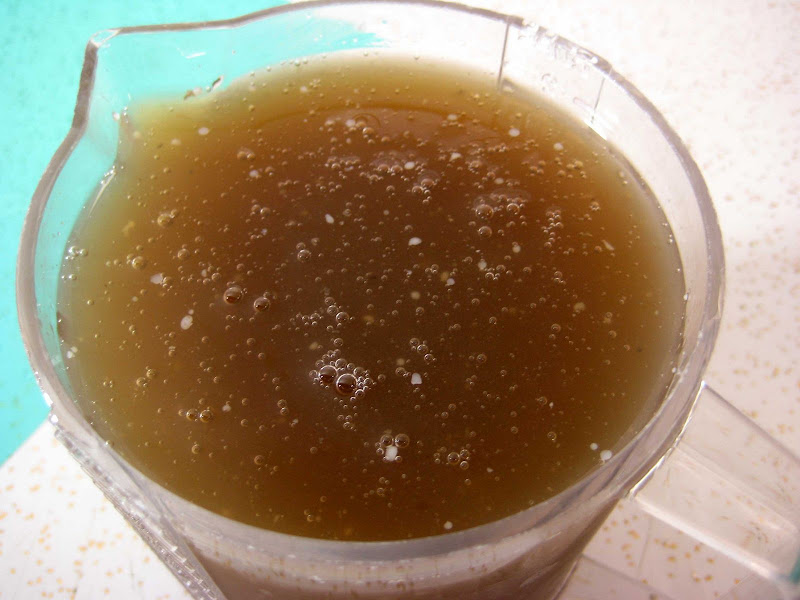
Here's my pho stock out of the fridge which I defatted by pouring through a fine mesh strainer. A good sign for the stock is the gelling from the refrigeration. This means a lot of flavor was squeezed out of the soup bones and more. :-) I have five (5) cups remaining after serving pho on Monday.
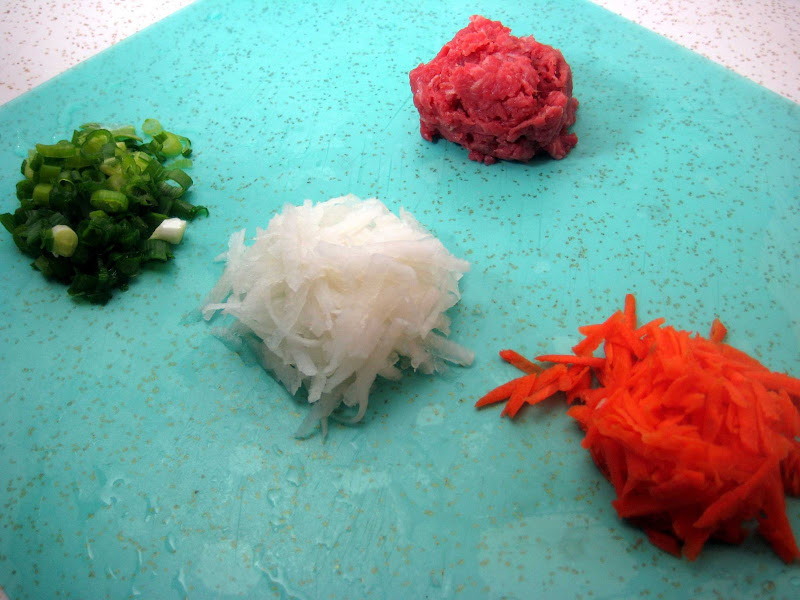
Here’s what I did to clarify the Pho broth... Green Onion, coarsely cut 1/4 C Daikon, shredded 1/4 C Carrots, shredded 1/4 C lean Beef, minced (trim off the fat)
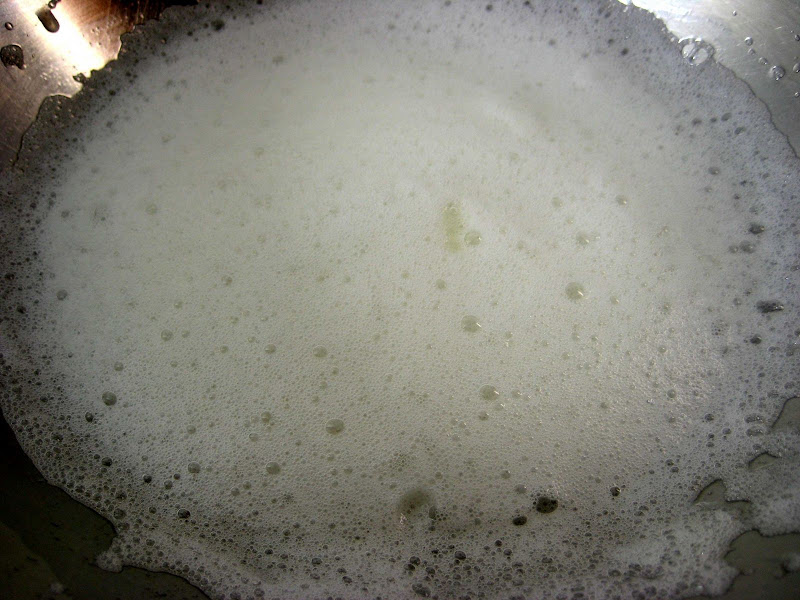
Two egg whites were whipped into a soft foam. I know Julia suggested using 4 egg whites, but that just seems like too much. In other words, I’m being cheap. Lol!
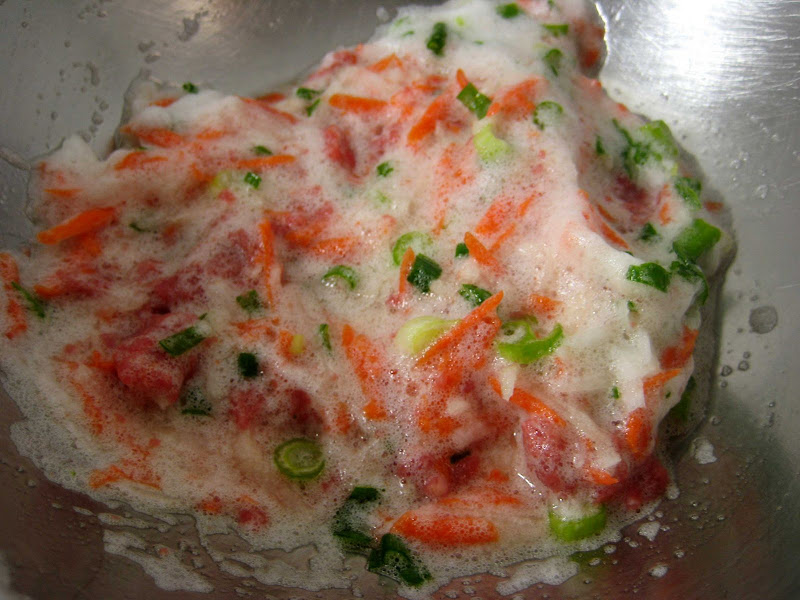
Mixed all the ingredients together into the egg whites.
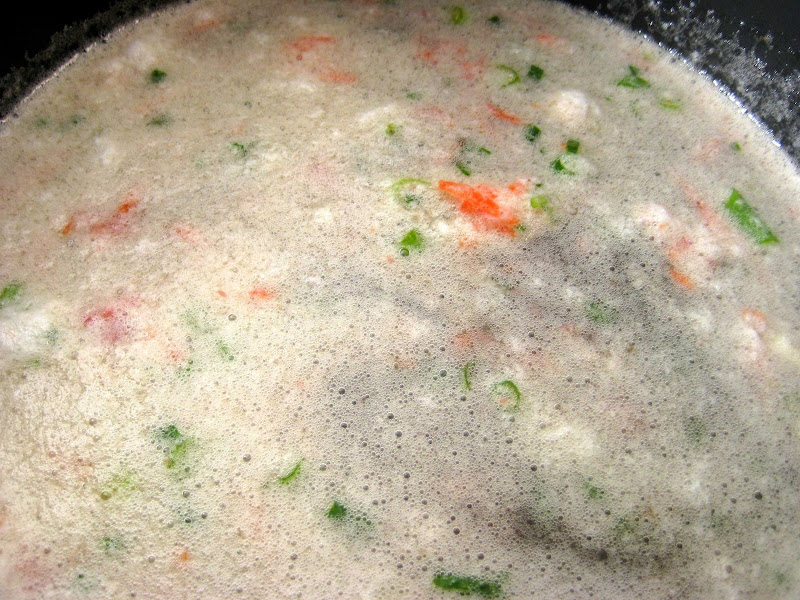
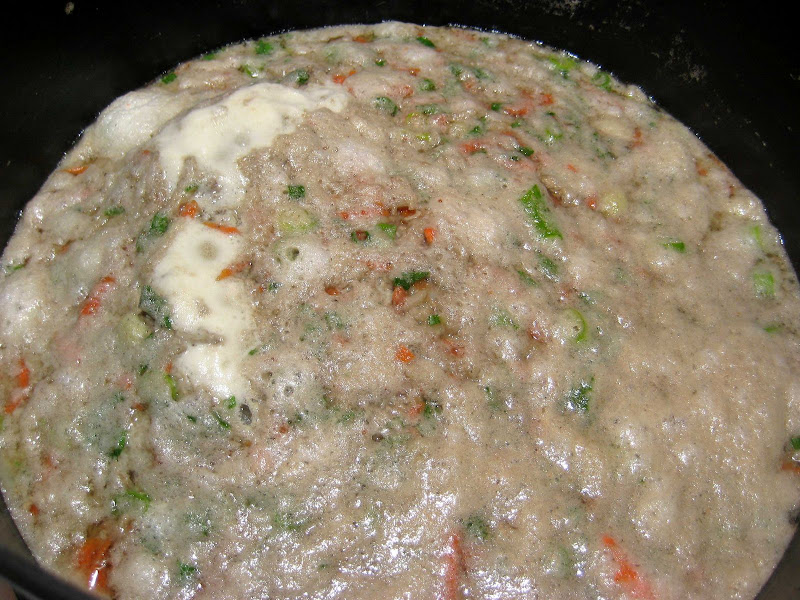
The egg white concoction was thoroughly mixed into the cold broth.
The broth was slowly brought to a simmer and allowed to simmer for about 35 minutes.
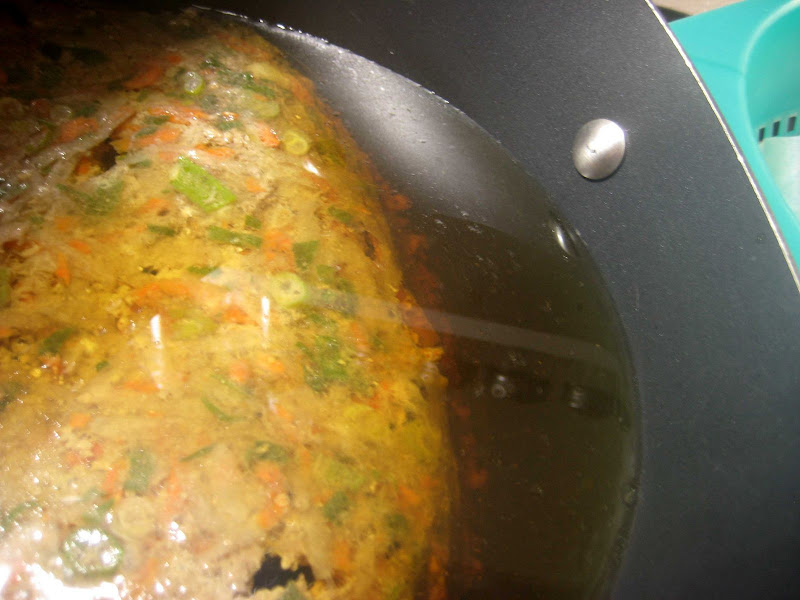
Wow! It worked! I'm about to decant the broth into a colander lined with a coffee filter.
Before Clarifying (From Monday)
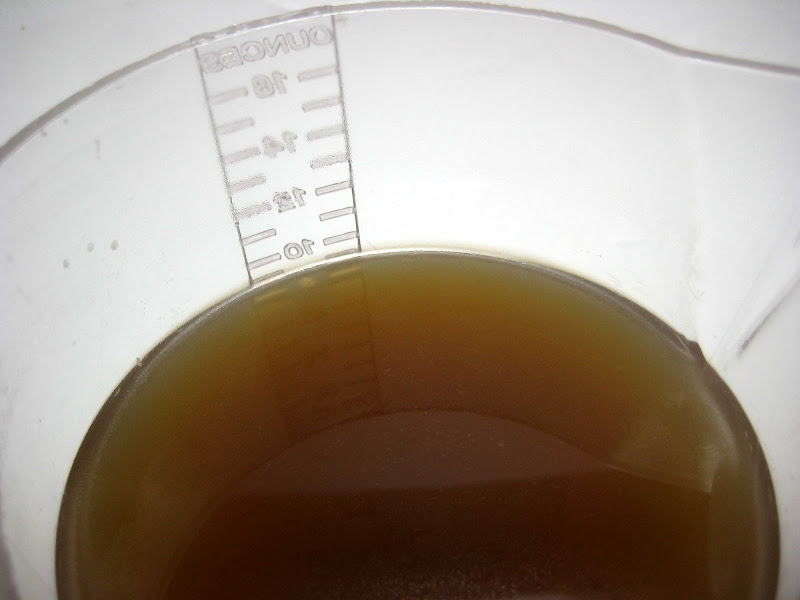
I would say it was a success. The muddiness is gone and now the broth is transparent. The broth looks like apple juice or apple cider vinegar. The extra ingredients also added more flavor to the so-so broth.
After Clarifying (Today)
More Info… I found this discussion about clarifying broths using egg whites. Also, it looks like someone watched the Iron Chef episode and was curious about clarifying broth too. :-) http ://forums.egullet.org/index.php?showtopic=112366