For this month, Jenn and Jill decided to focus on a technique that seems intimidating to many, but with a little practice it’s really not that hard at all – poaching. All poaching means is cooking something in simmering (not boiling) water. And what more perfect way to practice the skill of poaching than learning how to poach an egg? They can make a tasty breakfast, or salad accompaniment; there are so many different ways to use poached eggs, and they are used in cuisines from a variety of cultures.
The 1st recipe is one of the most well known poached egg dishes: eggs benedict – an open sandwich of English muffin, Canadian bacon, poached egg, and hollandaise sauce. This rich and decadent dish can be served as a really nice breakfast or brunch for having company over, and is sure to impress! The “daring” with this dish is in successfully poaching an egg in water, as well as making one of the famed mother sauces of France, the hollandaise.
Our 2nd recipe, oeufs en meurette (eggs in meurette sauce), is a classic dish from the region of Bourgogne (Burgundy) in France. It involves poaching an egg in a red wine/stock, which will then turn into a fabulous reduction sauce. One serves the poached egg on top of fried croûtes with sauce, bacon, mushrooms and pearl onions. This is also a great dish for breakfast/brunch as well.
[Eat4Fun - For this challenge I'm making Hollandaise sauce and Bacon Eggs Benedict Deluxe. The deluxing is in the form of tomatoes, mushrooms and sauteed spinach.
Also, I've taken a whole new approach to documenting my results. I'm going video!]
Mandatory Items: To use the technique of poaching an egg.
Recipe Sources:
Hollandaise sauce by Alton Brown
[It's been a long time since I've made Hollandaise. The last time I ended up with mayonnaise. I didn't know about the trick of adding hot water to thin it out the mayonnaise thick sauce.]
Eggs Benedict
[To be exact, Bacon Eggs Benedict Deluxe]
Ingredients
4 eggs (size is your choice)
2 English muffins*
4 slices of Canadian bacon/back bacon (or plain bacon if you prefer)
Chives, for garnish
Splash of vinegar (for poaching) [I used 2 T vinegar per quart of water.]
For the hollandaise (makes 1.5 cups):
3 large egg yolks
1 tsp. (5 ml) water
¼ tsp. (1 ¼ ml/1½ g) sugar
12 Tbl. (170 g/6 oz.) unsalted butter, chilled and cut in small pieces [Used salted butter]
½ tsp. (2 ½ ml/3 g) kosher salt [Since I used salted butter, additional salt was not needed.]
2 tsp. (10 ml) freshly squeezed lemon juice
Pinch cayenne pepper (optional)
Directions:
Hollandaise Sauce
1. Fill a medium saucepan halfway with water and bring to a simmer.
2. Cut the chilled butter into small pieces and set aside.
3. Whisk egg yolks and 1 tsp. (5 ml) water in a mixing bowl large enough to sit on the saucepan without touching the water (or in top portion of a double boiler). Whisk for 1–2 minutes, until egg yolks lighten. Add the sugar and whisk 30 seconds more.
4. Place bowl on saucepan over simmering water and whisk steadily 3–5 minutes (it only took about 3 for me) until the yolks thicken to coat the back of a spoon.
5. Remove from heat (but let the water continue to simmer) and whisk in the butter, 1 piece at a time. Move the bowl to the pan again as needed to melt the butter, making sure to whisk constantly.
6. Once all the butter is incorporated, remove from heat and whisk in the salt, lemon juice, and cayenne pepper (if using).
7. Keep the hollandaise warm while you poach your eggs in a thermos, carafe, or bowl that you’ve preheated with warm water.
Poaching eggs -
8. If the water simmering in your pan has gotten too low, add enough so that you have 2–3 inches of water and bring back to a simmer.
9. Add salt and a splash of vinegar (any kind will do). I added about a tablespoon of vinegar to my small saucepan (about 3 cups of water/720 ml of water), but you may need more if you’re using a larger pan with more water. [I used 2 T of vinegar for every quart of water.]
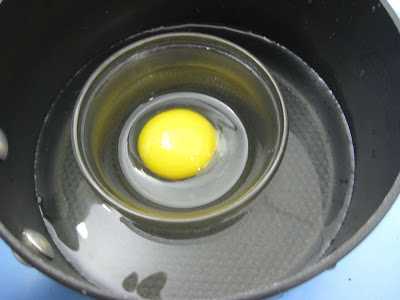
10. Crack eggs directly into the very gently simmering water (or crack first into a bowl and gently drop into the water), making sure they’re separated. Cook for 3 minutes for a viscous but still runny yolk.
11. While waiting for the eggs, quickly fry the Canadian/back bacon and toast your English muffin.
12. Top each half of English muffin with a piece of bacon. Remove the eggs with a slotted spoon, draining well, and place on top of the bacon. Top with hollandaise and chopped chives, and enjoy!
Bacon Eggs Benedict with tomato, mushroom and sauteed spinach.
Although the egg yolks turned out medium, cooked solid but still golden, the egg whites were very tender, almost melt in your mouth tender. That's the advantage of poaching.
Poaching slowly cooks protein at low heat so the protein molecules bind together loosely, which means tender.